Studyexperiment
Paper Heart
Folding a flexible surface into a moving volume
A paper study exploring how folding transforms a flat, flexible material into a three-dimensional form capable of movement.
Paper as a soft mechanism
Paper is one of the materials I return to often because of how quickly it moves between states.
It begins as a flat, lightweight and inexpensive surface. It can be cut almost immediately, folded by hand, marked, discarded and remade. But once folded, it also retains a trace of what has happened to it. A crease gives the material a kind of memory: the sheet begins to prefer certain directions of movement.
This makes paper especially useful for prototyping soft mechanisms.
Rather than treating softness only as something elastic or textile, I am interested in materials that can deform, fold, collapse and recover through their own structure. Paper sits somewhere interesting between flexibility and rigidity. It can remain light and responsive while still holding a three-dimensional form.
For this study, I wanted to use those properties to make a small moving heart.


From a flat sheet to a heart
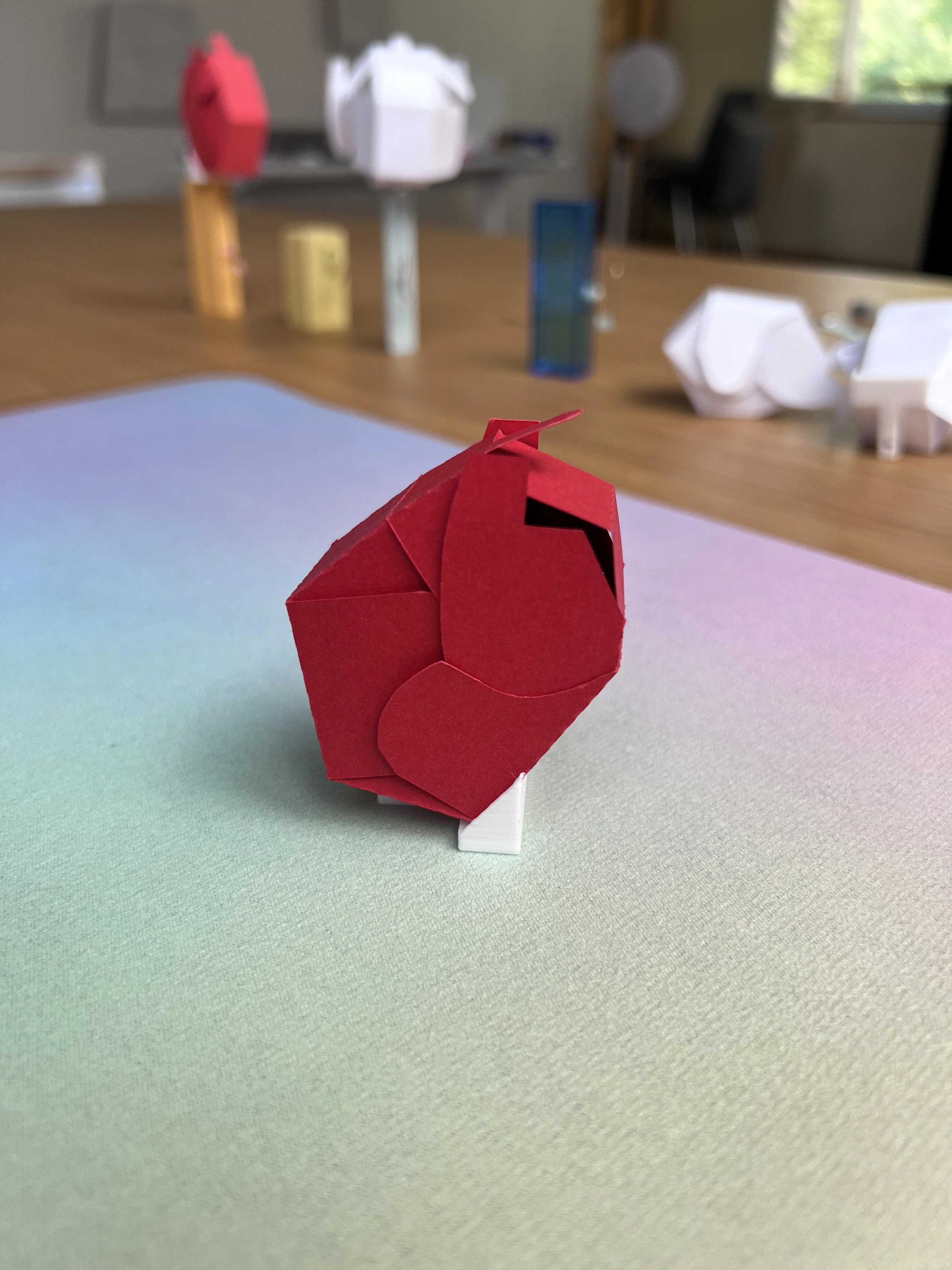
The starting point was a paper model of a human heart.
I was interested in keeping the form closer to an anatomical heart than to the conventional heart symbol, while still simplifying it enough to become a small mechanical object.
The movement I wanted was equally simple: a suggestion of pumping.
The heart does not reproduce the biological movement of a real heart. Instead, the folded paper body opens and closes, producing a small contraction and expansion that can be read as a beat.
The geometry of the folds became part of the mechanism itself.
When pressure is applied at two points, two main flaps begin to close. Those flaps then push the neighbouring surfaces, and the movement propagates through the folded structure.
The paper is therefore not only the surface of the object.
It is the moving mechanism.
Iterating the fold
The first prototypes were made with ordinary 90 gsm A4 printer paper.
This was useful because it allowed me to make changes quickly without worrying about wasting material.
The first versions revealed several small problems.
One fold was missing, which prevented part of the structure from collapsing correctly. In another iteration, some tabs were too short to overlap properly, while others were unnecessarily long and interfered with the movement.
Each version changed only small parts of the template.
The process became less about designing the final shape in advance and more about observing what the material was doing:
How far does this flap need to travel?
Where does the paper resist?
Which fold initiates the movement?
Which surface pushes the next one?
At what point does the structure begin to close by itself?
These small adjustments gradually changed the heart from a static paper model into a deformable structure.
The missing hand
One problem remained.
The folded heart worked when I held it in a particular place with my fingers, but I could not find a satisfactory way to make the paper close itself at that point.
The hand was effectively becoming part of the mechanism.
Instead of redesigning the entire paper structure, I decided to replace that gesture with a very small additional component.
I designed and 3D printed a simple brace that holds the heart at the same points where my fingers had been holding it.
The brace acts on two opposing tabs.
As those two tabs move inward, they begin to close the neighbouring folded surfaces, which in turn pull the rest of the heart into its contracted form.
This small rigid component made the soft mechanism much more predictable without replacing the behaviour of the paper itself.
Most of the movement still comes from the folds.
The printed part simply gives the mechanism a stable point from which to act.
Finding the right paper
Once the geometry was working more reliably, I moved from printer paper to 180 gsm paper.
This changed the behaviour significantly.
The heavier paper has enough stiffness to hold the three-dimensional heart more clearly, but it remains flexible enough for the folded surfaces to move repeatedly.
A much heavier material would begin to resist the mechanism.
A lighter material collapses easily but does not hold the anatomical volume as convincingly.
At 180 gsm, the paper currently sits in a useful middle ground between structure and flexibility.
The final template was cut using a Silhouette Cameo 5 Alpha, allowing the fold geometry and tabs to be reproduced consistently across iterations.
What this study is testing
This small heart is not yet about producing a finished kinetic sculpture.
It is a material test.
It asks what happens when movement is embedded into the construction of a flexible surface rather than imposed on it from outside.
The experiment also reinforces one of the central questions of Soft Mechanisms:
How little mechanical intervention is needed before a soft material begins to behave like a moving body?
Here, a flat sheet becomes a volume.
A fold becomes a hinge.
A tab becomes a point of force transmission.
And a very small external movement becomes something that can be perceived as a beat.
Files
- SVG template: download / view SVG
- PDF template: download / view PDF

Fabrication
The current version uses:
- 180 gsm paper
- Silhouette Cameo 5 Alpha
- scored / folded paper geometry
- one small 3D-printed brace
The template and brace are still being refined as the study develops.