Studyexperiment
Miura-ori in Organza
Heat-setting a hand-folded textile mechanism
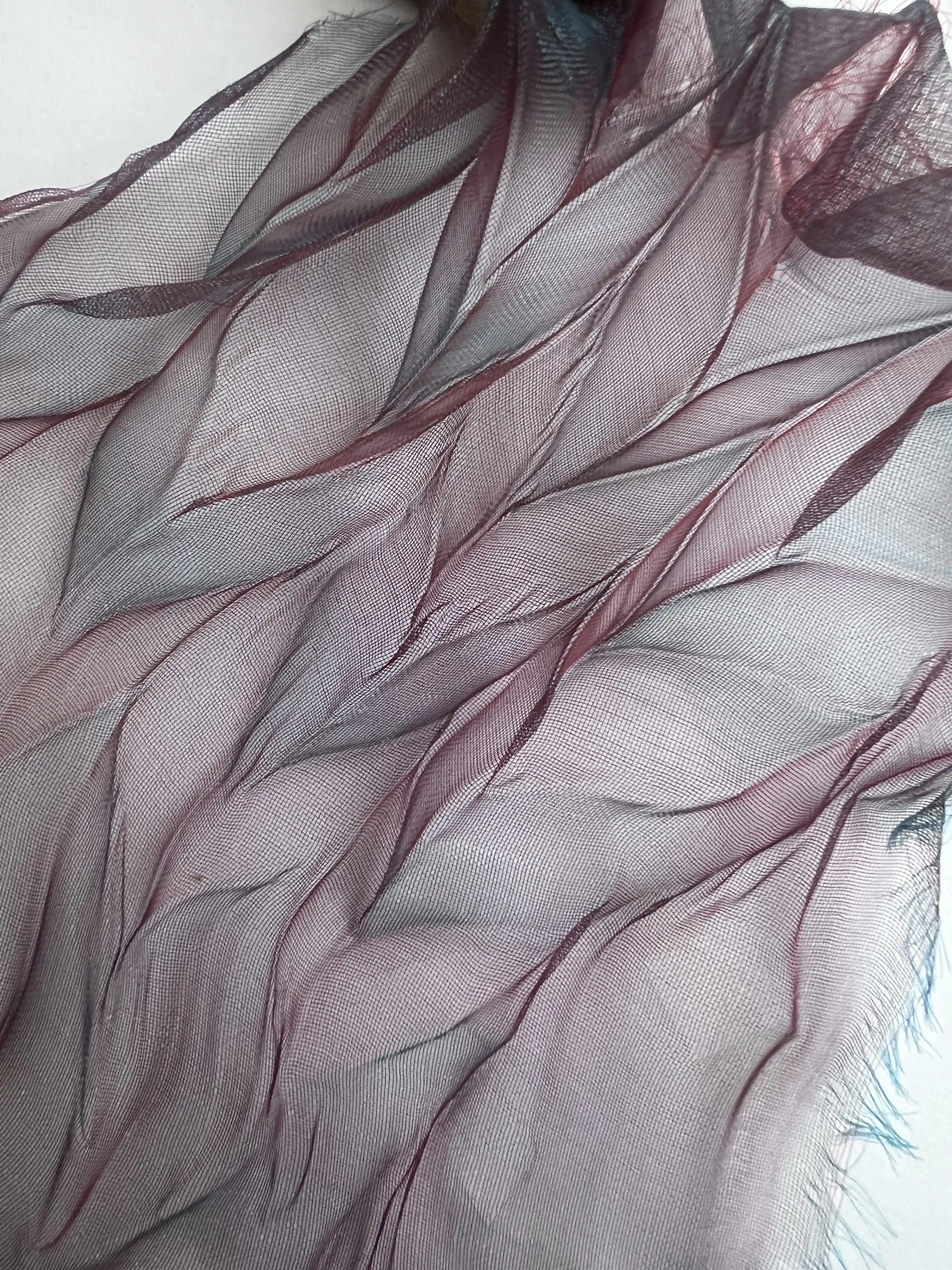
A first test of heat-setting polyester organza between hand-folded Miura-ori paper molds, exploring how a textile surface can retain folds while remaining able to expand and contract.
A fold that can move
I have been looking for ways to give a soft surface a mechanical behaviour without immediately adding a rigid skeleton. Miura-ori offered a useful starting point: a repeated arrangement of mountain and valley folds that allows a surface to open and close as a connected structure.
The question for this first experiment was simple: could a piece of organza remember a Miura-ori pattern after the paper mold was removed, and still move between compressed and expanded states?
Rather than beginning with a digitally fabricated mold, I wanted to fold the paper by hand. The geometry is accessible enough to explore directly from a square sheet, without a scoring machine or elaborate tooling. I enjoy that the construction can begin with an ordinary piece of origami paper and a sequence of folds.
Setup
For the first test I used:
- Fabric: 100% polyester organza, cut to approximately 15 × 15 cm.
- Molds: two square origami-paper sheets, each 15 × 15 cm, folded by hand into a Miura-ori pattern.
- Assembly: organza enclosed between the two folded paper molds, then collapsed as a paper–fabric–paper sandwich.
- Equipment: electric oven with upper and lower ventilation/heating, using a low temperature setting.
- Setting: 65 °C.
- Preheating: 10 minutes.
- Heating with the sandwich inside: 10 minutes with the oven switched on.
- Cooling: the sandwich stayed inside the switched-off oven until it had cooled; the additional cooling time was not measured.
Because both paper molds were folded manually, the creases were not perfectly identical. There were small differences between the two sheets, but they still fitted together well enough to hold the organza in the intended geometry. This imperfect alignment is worth recording: at this scale, the process worked without precision-cut matching molds.
Heat-setting process
I folded both origami sheets into the Miura-ori configuration, cut a matching square of organza, and placed the fabric between the paper layers. Then I compressed the assembly along the existing folds so that the paper guided the fabric into the same pattern.
I preheated the electric oven for 10 minutes at 65 °C, placed the folded sandwich inside, and left the oven on for another 10 minutes. Rather than removing the piece immediately, I switched off the oven and let the whole assembly cool inside it. This means the textile remained enclosed and folded during a longer, gradually decreasing temperature exposure. I did not measure the actual temperature inside the paper sandwich or the length of the cooling period.
This is a record of the parameters used in one studio experiment, not a validated oven protocol. Future tests should take account of the fire risk of paper and textiles in ovens, the accuracy of oven temperature controls, and the suitability of the equipment for heat-setting.
Observation
The organza retained the Miura-ori geometry surprisingly well when removed from the paper molds. More importantly, the result was not simply a textile with a decorative pleated surface. The folded fabric could still open and close along the pattern.
This is the behaviour I was looking for. The textile remains lightweight and translucent, yet the pattern gives it a direction of movement and a temporary three-dimensional organization. Opening and closing are no longer arbitrary deformations of a loose sheet: they are guided by a repeated fold geometry.
At this stage, I have observed the movement manually. I have not yet measured its opening range, resistance, durability over repeated cycles, or whether the pleats retain the same shape after prolonged use.
The modest mismatch between the handmade molds did not prevent this first result. That makes the manual process particularly appealing: the fold can be explored and adjusted by hand before there is any reason to standardize its manufacture.
Why it matters for Soft Mechanisms
This first sample suggests a useful distinction between softness as a material property and softness as a mechanical system. Organza begins as a flexible textile. Through folding and heat-setting, that same textile acquires a repeatable path of movement. The structure does not need to be attached to a series of separate hinges: the folds themselves organize the motion.
There is also something compelling about the material combination. The transparency of the organza makes the geometry visible without turning it into a heavy solid object. Its lightness suggests the possibility of larger membranes whose change of shape could be driven by relatively small mechanical interventions.
For Artificial Emotion, the interest is not only in making a fabric move, but in discovering how movement emerges from the relationship between material, geometry and actuation. Here, geometry already does much of the work. The next problem is how to introduce a mechanism without overwhelming the textile's own behaviour.
Next
The next step is to build an actuation mechanism and observe how the organza responds when the opening and closing are driven from selected points rather than by my hands. I want to find out where the textile can be held or pulled, how the motion travels across the folds, and how much force is needed.
I also want to make a larger version, using the same hand-folding approach where practical. Scaling up should make it easier to observe the overall deformation and reveal whether the fabric still holds its pattern across a larger surface.
For anyone who prefers a printed folding guide over freehand construction, I have also prepared an A3 SVG Miura-ori pattern. It is an option, not a requirement: the hand-folded process is central to what I enjoyed about this experiment.
Files
- Miura-ori SVG folding pattern (A3): view / download SVG

Questions to carry forward
What is the smallest intervention that can open or compress this folded membrane? Can the pattern be cycled repeatedly without losing its memory? Does a larger sheet behave like the small sample, or does scale introduce new resistance and unevenness?
For now, the finding is straightforward: the fold survived the removal of the mold, and the fabric still moves.