From Paper Molds to Folded Textiles
Reiko Sudō / NUNO; Uyen Nguyen; Instructables contributors · 1997–2020 · research
Three complementary references on hand-folded, heat-set textiles, from an accessible paper-mold tutorial to origami fashion research and Reiko Sudō's Origami Pleats.

Photo: Reiko Sudō, Hiroko Kobayashi, Mizue Okada, Nuno Corporation, Takekura Co., Ltd., Textile Length, ‘Origami Pleats’ from ‘Origami’ Series, 1997, Los Angeles County Museum of Art, Gift of Grace Tsao, photo ©Museum Associates/LACMA. source_
Why it matters
In the Soft Mechanisms research thread of Artificial Emotion, folding is not only a visual treatment. It can give a flexible surface preferred directions of motion: a fabric that expands, contracts, collapses and returns to a recognisable geometry.
These three references approach this possibility from different directions: a practical tutorial for making folded fabric with paper molds, a research paper relating origami geometry to wearable structures, and a textile artwork that demonstrates the expressive potential of hand pleating and heat-setting.
Together they form a useful context for my Miura-ori organza experiment. They are not three examples of the exact same crease pattern: the Instructables example uses a V-grid, Nguyen discusses several origami geometries including Miura-ori variations, and NUNO’s Origami Pleats is an origami-inspired pleated textile.
1. Paper Mold Origami Fabrics 2 — V Grid
Type: Practical making tutorial
Platform: Instructables
Source: Paper Mold Origami Fabrics 2 — V Grid
This tutorial demonstrates a direct fabrication principle: prepare two folded paper molds, sandwich a synthetic fabric between them, refold and compress the assembly, and apply heat so that the fabric retains the folds.
The author selects synthetic organza for its transparency and relative stiffness. Heavier drawing paper (90 lb) is used to make molds capable of holding their shape and producing crisp creases.
The documented oven treatment is approximately 160 °C for 25 minutes. This is a reported process parameter, not a universal recommendation for every fabric, paper, or oven. It also concerns a V-grid, not Miura-ori.
What interests me here is how uncomplicated the tooling can be. The paper is simultaneously the drawing, the forming tool, and the temporary structure that holds the textile while it acquires a crease memory. The end result is a textile that can be manipulated after the mold is removed.
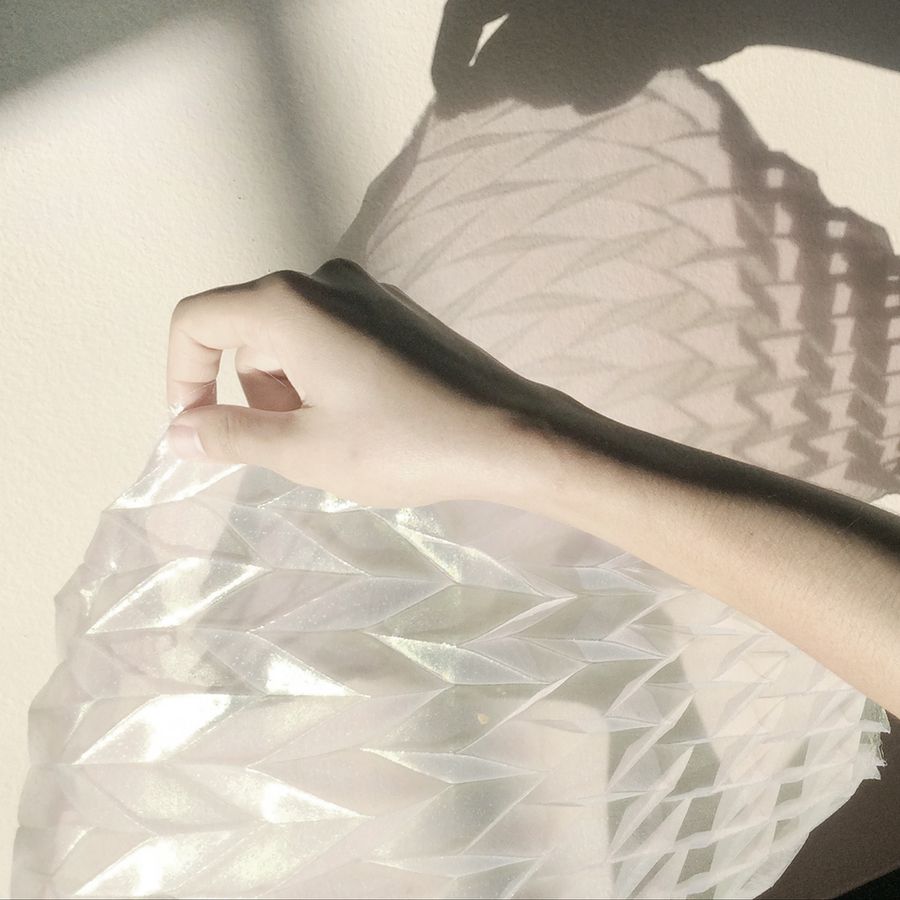
Photo: Check the Results. source
2. Uyen Nguyen — Folding Fabric: Fashion from Origami (2020)
Type: Conference research paper
Author: Uyen Nguyen
Publication: Proceedings of Bridges 2020: Mathematics, Art, Music, Architecture, Education, Culture, pp. 93–102
Paper: Read the PDF
Archive entry: Bridges 2020
Nguyen studies how origami ideas can be transferred from paper to garments, with particular attention to flat-foldability, the memory of folds, structural stiffness, and the geometry of changing forms. Her experiments include heat-set synthetic textiles and versions with semirigid panels attached to fabric facets.
Her heat-setting method uses two matching paper molds with fabric between them. The folded assembly is placed in an oven, with a tray of water underneath to introduce steam. For polyester, she reports a typical temperature of about 300 °F (approximately 149 °C), followed by cooling while the piece remains folded. She does not specify a single universal baking time in that description and explicitly describes damaging fabric when the temperature was too high.
A particularly useful distinction emerges between retaining a crease and supporting a three-dimensional surface. Heat-setting introduces fold memory, but larger facets may still droop under gravity. Smaller facets or added support can change that behaviour. Nguyen also discusses a chevron top that varies the widths of a Miura-ori-derived pattern according to the Fibonacci sequence.
For Artificial Emotion, this raises a question beyond whether organza can be pleated: what happens to the movement when the cell size, stiffness and scale change?
3. Reiko Sudō / NUNO — Origami Pleats (1997)
Type: Textile artwork / design reference
Year: 1997
Design: Reiko Sudō, with collaborators including Hiroko Suwa and Mizue Okada
Producer: NUNO Corporation, Japan
Material / process: 100% polyester organza; hand folding, heat-setting, and in some versions heat-transfer printing
Artist / studio source: NUNO — Origami Pleats
Museum documentation: LACMA collection · Cooper Hewitt · Powerhouse Collection
Origami Pleats is an especially compelling precedent because the pleat is both a manufacturing technique and the character of the finished work. The transparent textile is hand-folded into geometric angles and fixed with heat. When opened, the pleats produce a changing play of translucency, depth and volume; when released, certain scarf versions spring back toward their compact folded state.
The process involved several collaborators, not Reiko Sudō alone. Museum documentation credits Mizue Okada with developing the pleating technique. The LACMA object record names Reiko Sudō, Hiroko Kobayashi, and Mizue Okada, with NUNO and Takekura Co., Ltd.; NUNO’s project page names Reiko Sudo, Hiroko Suwa, and Mizue Okada. Credits depend on the particular object and source.
The Cooper Hewitt account describes a paper mold that holds polyester in its folded state during heat treatment. Coloured transfer paper can be added to introduce gradations of colour while the form is being fixed.
What is compelling here is not simply the resemblance to folded paper. It is the combination of transparency, physical memory and reversible-looking movement. The textile can be compressed into a dense object and expanded into a larger, lighter surface.

Photo: Reiko Sudō, Hiroko Kobayashi, Mizue Okada, Nuno Corporation, Takekura Co., Ltd., Textile Length, ‘Origami Pleats’ from ‘Origami’ Series, 1997 (alternate view), Los Angeles County Museum of Art, Gift of Grace Tsao, photo © Museum Associates/LACMA. source
Connections to Soft Mechanisms
These references suggest three related but distinct questions:
- Fabrication: Can a hand-folded paper mold reliably transfer a crease pattern to synthetic organza?
- Mechanics: How does the size of a folded cell change the textile’s ability to expand, contract, support itself, and respond to a small force?
- Expression: How do transparency, repetition and folding memory change the appearance of movement?
The first small Miura-ori organza study has already produced a surface that takes the fold pattern and opens and closes. The next question is how to actuate it, and how the behaviour changes in a larger sample.
Hand folding remains an important part of this direction. Slight irregularities are not necessarily defects: they reveal the relationship between the maker, the temporary paper mold and the resulting textile. An SVG pattern offers a reproducible alternative without making digital scoring or automated folding a requirement.
Sources and image credits
- Paper Mold Origami Fabrics 2 — V Grid. Instructables. https://www.instructables.com/Paper-Mold-Origami-Fabrics-2-V-Grid/
- Nguyen, Uyen. “Folding Fabric: Fashion from Origami.” Bridges 2020, pp. 93–102. https://archive.bridgesmathart.org/2020/bridges2020-93.pdf
- NUNO Corporation. “Origami Pleats” (1997). https://www.nuno.com/en/textile/origami-pleats/
- Los Angeles County Museum of Art. Textile Length, ‘Origami Pleats’ from ‘Origami’ Series (1997), accession M.2006.151.8. https://collections.lacma.org/object/133888
- Cooper Hewitt, Smithsonian Design Museum. “Origami Pleat,” 6 March 2019. https://www.cooperhewitt.org/2019/03/06/origami-pleat/
- Powerhouse Collection. ‘Origami Pleats’ textile by Reiko Sudo for NUNO Corporation. https://collection.powerhouse.com.au/object/354375