Studyexperiment
A Membrane Under Tension
A modular tension study with nylon mesh, drywall tape and removable connections
An exploratory test of how a thin, elastic textile surface deforms under hand-applied tension, using found workshop materials and reversible connections to make iteration easier.
Question
I have been looking at structures made from fabric that change shape when a thread is pulled. Tensile structures initially seemed like the right term, especially because tension is essential to how these surfaces hold their form. But the architectural examples I encountered — tensile roofs, canopies and tent-like membranes — are often designed to remain in a stable, tensioned configuration. My interest is in the movement between configurations: a surface that can be pulled, released, reshaped, and pulled again.
Kinetic membranes describes part of this interest, although it is also the title of a particular artwork I have been studying. I would rather use the expression descriptively than adopt another artist's title as the name of my research. Actuated textile membranes, tension-driven textile surfaces, and kinetic textiles are useful adjacent terms. None is a perfect umbrella for all flexible materials. In this experiment, kinetic textile membranes describes the specific subject, while Soft Mechanics remains the wider research thread.
The practical question was straightforward: how can I construct a light, tension-responsive textile sample whose attachment points are strong enough for repeated pulling, yet easy to reposition or replace?
I was especially interested in reversibility. The membrane should not simply be stretched into one final arrangement. I wanted a setup that could become a small testing instrument for different fabrics, tensions and positions.


Setup
The starting material was a piece of very thin, porous, stretchy mesh of the kind associated with tights or pantyhose. It is reasonable to call this hosiery mesh or stocking fabric. Such fabrics are often knitted from nylon (polyamide) and elastane, but I have not verified the fibre composition of this particular sample; nylon mesh is therefore a working description rather than a confirmed specification.
I assembled a perforated frame from four pegboard pieces, making a field of possible attachment positions. Rather than tying every line permanently to the fabric or frame, I wanted connections that could move from hole to hole and allow the textile sample to be removed without undoing a succession of knots.
The materials came from very different corners of the workshop:
- Stretch hosiery-like mesh: the deformable textile membrane.
- Self-adhesive drywall joint tape (Fugenband): a lightweight open grid used to reinforce vulnerable regions of the mesh.
- Metal eyelets / grommets: small flanged metal rings set through the reinforced textile using an eyelet-setting tool, of the kind used in scrapbooking (including tools such as the Crop-A-Dile).
- Clear elastic cord or thread: the transparent tension lines I already had from a craft or stationery purchase; its polymer and exact elasticity are not confirmed.
- Long tubular beads (bugle beads): removable transverse stops on the far side of the pegboard holes.
- Four pegboard sections: a modular perforated frame for exploring alternative tension geometries.
I did not begin with calibrated loads or a motor. The first actuator was my hand.
An unexpected construction material
One of the most useful components was something I had purchased at a hardware shop without knowing what it was for. I liked the look of the little woven grid and kept it in the studio. Only later, when I needed a flexible reinforcement that was neither solid nor excessively rigid, did I remember it.
The roll is self-adhesive fiberglass mesh drywall joint tape (Gipsplatten-Fugenband, or Fugenband in German). In construction, sheets of gypsum plasterboard — drywall — meet along seams. The joint tape is pressed over those seams and embedded in joint compound, helping reinforce the finished joint and distribute stresses that could otherwise lead to visible cracks. The open mesh lets the compound pass through and bond across the seam. In its intended application it is not the tape alone that finishes or structurally repairs the wall: it works together with the compound.
The roll shown here is labelled 48 mm wide and 20 m long. Its open grid was particularly appealing for this test. It could reinforce an attachment zone without adding a continuous, impermeable patch, and it could still bend with the hosiery mesh. I used small sections near the corners / points where the tensile forces would enter the fabric.
This is a studio adaptation rather than the manufacturer's intended application. The adhesive, glass fibres and textile will not necessarily survive repeated loading in the same way. Cut fibreglass edges may shed irritating fibres, so they should be handled carefully and not treated as a skin-contact textile.
Joining construction materials to scrapbooking hardware
The next problem was how to connect a pulling thread to a porous, elastic fabric without concentrating all the force at one tiny point. If a line is tied directly through a soft knit, the yarns can distort or tear around the knot.
I placed the drywall mesh tape over the attachment region and added a metal eyelet through the layered materials. An eyelet — also called a grommet in English, depending on size and context — is the small metal ring with a hole through its centre. An eyelet setter flares or rolls the metal shaft to grip the material. It is not a pop rivet: the centre remains open so a cord can pass through.
That gave the thread a defined passage and reinforced the contact area. It does not eliminate stress concentration, but it makes the connection easier to handle and, potentially, more repeatable than piercing the bare mesh each time.
I enjoy this collision of material vocabularies: a reinforcement product from drywall construction, a metal eyelet from paper crafts, and an elastic knitted fabric more closely associated with clothing. None of these materials was designed specifically for a kinetic sculpture, but their properties became useful when placed in relation to one another.
Tubular beads as reversible stops
I also wanted to avoid permanently knotting the line on the outside of the pegboard. Permanent knots are quick at first, but they introduce friction into every subsequent iteration: cut the thread, undo a tight knot, restring, retie. Stitching and hot glue have a similar trade-off. They are often excellent for a fast proof of concept, but less helpful if the experiment depends on constantly changing its configuration.
Instead, I used long tubular beads, commonly called bugle beads in English. The clear elastic line passes through a pegboard hole and through a bead on the other side. When the bead sits crosswise against the board, it becomes a simple stop that prevents the line from pulling back through the hole. It can be lifted and repositioned when I want to change the attachment point.
This tiny detail mattered disproportionately. A bead is not a dedicated mechanical fastener, yet here it acts as a removable anchor. The exact holding behaviour depends on the relationship between bead length, hole diameter, cord tension and the way the line is secured to the bead; it should not be assumed safe for significant suspended loads. For a lightweight hand-tested fabric sample, it offers the possibility of changing the experiment without remaking it.
Testing by hand
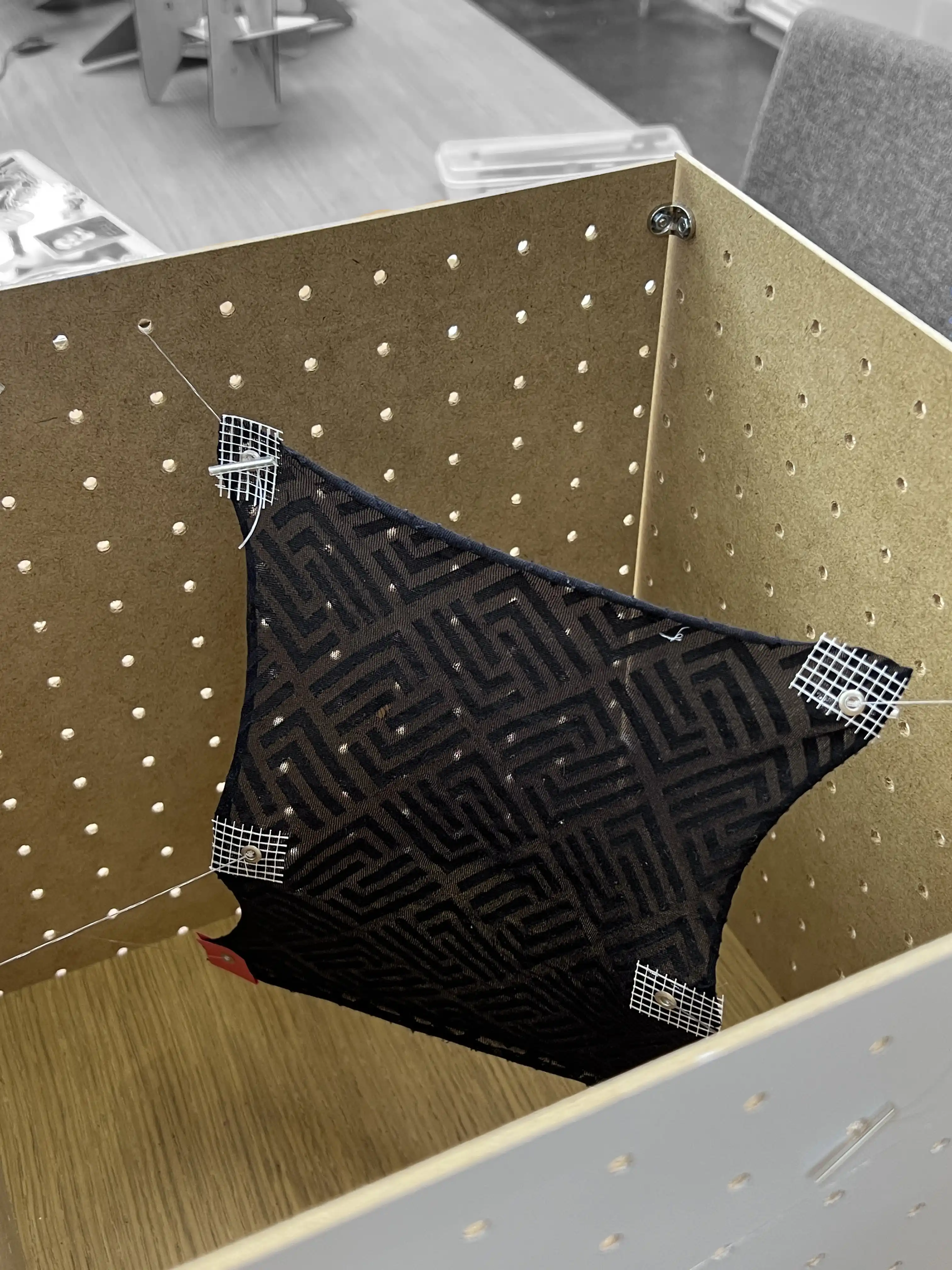
With the membrane mounted on the perforated frame, I pulled the clear elastic lines manually and watched how the material responded. The hole grid allowed me to change where the forces entered the setup, and the detachable stops let me relocate the lines or remove the sample.
The tests were exploratory, not a quantitative evaluation. I did not measure applied force, extension, displacement, repeatability, or fatigue. I was looking first for a legible relationship between where a line pulls, how tension travels through the knit, and what three-dimensional deformation appears.
The visible movement depends on more than the fabric alone. It is produced by a system: porous elastic knit, locally reinforced points, eyelets, elastic lines, selected pegboard holes and a pulling hand. Changing any one of these could change the response. In particular, the elastic line can stretch as well as the textile; that makes it a useful compliant connection but also complicates the separation of the membrane's own response from the response of the actuation line.
Observation
This experiment revealed a useful design requirement before it established a finished mechanism: a textile study needs an equally flexible method of attachment and revision.
The drywall tape provided a possible way of spreading the forces around vulnerable attachment points without immediately introducing a stiff plate. The eyelets made clear, repeatable holes for connecting lines. The tubular beads turned an ordinary pegboard into a reconfigurable field of tension points. Together, these small decisions reduced the effort needed to try another arrangement.
The membrane can be pulled and allowed to relax, but the current documentation does not establish a consistent, controlled return cycle. That distinction matters to me. The longer-term interest is not simply in fabrics that can be stretched into interesting shapes, but in textiles that can move out and back — contraction and release, deformation and recovery — many times.
I also want to compare different kinds of return: one produced by the elasticity of the fabric itself, one by an elastic cord, and one by an opposing force such as a spring or counterweight. They may look similar at first but constitute different mechanical systems.
Why this matters for Soft Mechanics
The research is not about making a static tensile canopy at miniature scale. It is about learning how a textile surface might become a moving body.
The frame is deliberately simple. Its purpose is to make questions testable: what changes when I move an anchor to a neighbouring hole? How many tension points are necessary to produce a particular fold or volume? What happens when a more rigid organza replaces the elastic knit? Does a porous reinforcement help the fabric survive repeated pulling, or does it introduce a new point of failure?
There is also a practical method emerging from the test. I repeatedly return to low-friction prototyping, not because every prototype must be effortless, but because I want to preserve the possibility of play. A modular connection is valuable when it keeps the next experiment close at hand. It lets the laboratory remain open to a material found by accident, an unexpected configuration, or a comparison with another fabric.
At this stage, the useful outcome is as much the reconfigurable testing apparatus as the particular textile shape it produces.
Next
The next step is to compare more than one membrane on the same grid — for example, a stretchy hosiery knit and a lightweight organza — while keeping the positions of the pulling lines as comparable as possible. That should make it easier to see what comes from the textile's own material behaviour and what comes from the attachment geometry.
I also want to test repeated pull-and-release cycles, observe whether the eyelets and tape remain in place, and compare clear elastic cord against a less extensible line. Only after that would I introduce a pulley, a small spool or a counterweight to replace the hand with a more controlled mechanical input.
The immediate research questions remain open: How can a thin fabric return from deformation? What is the smallest number of tension points needed to produce a legible gesture? And how can the experimental apparatus stay modular enough to invite constant rearrangement?