Studyprototype
A Simple Crank
Revisiting a wood-and-wire mechanism for small kinetic experiments
A small wood-and-wire crank mechanism revisited from an earlier automata workshop, used here as a simple introduction to rotational and reciprocating movement.
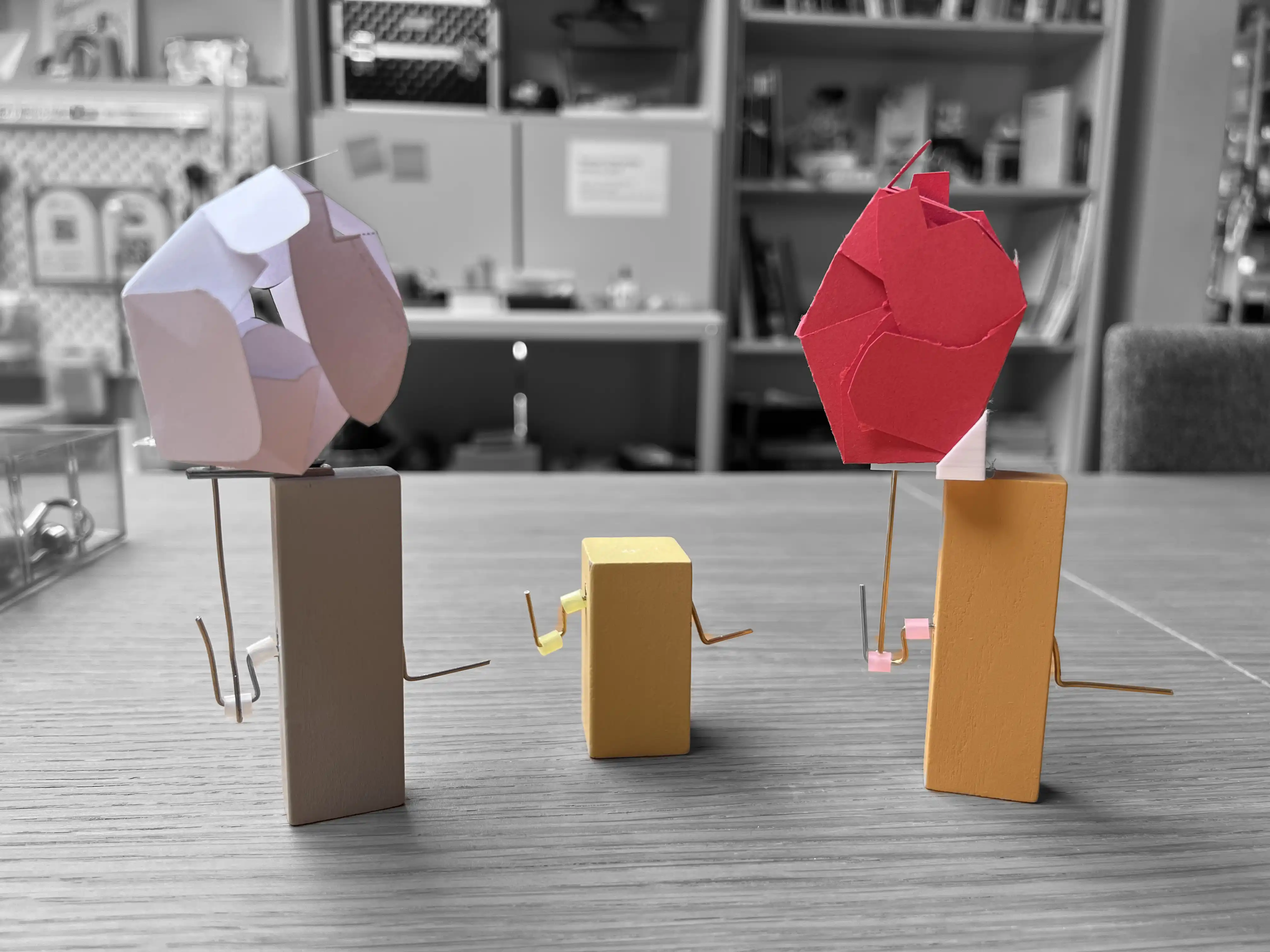
Returning to a simple mechanism
I first encountered this particular crank exercise through an online automata workshop in 2022, organised by Cabaret Mechanical Theatre together with Wonderful Idea Co.
The programme brought together automata making, tinkering and creative learning through a series of small mechanical experiments. It was led by Ryan Jenkins, whose work through Wonderful Idea Co. grows directly out of the tinkering practices developed at the Exploratorium's Tinkering Studio.
One of the first exercises was Cranky Contraptions: an extremely simple construction using a drilled wooden block and bent wire to explore how rotational movement can be transformed into other forms of motion.
I had already been following the work of the Exploratorium for many years through my own practice in Creative Learning and creative technology education. What stayed with me about this particular exercise was its economy.
Very little is required.
A block of wood.
A hole.
A piece of wire.
A few bends.
And suddenly there is a machine.


An earlier contraption
In the workshop, I extended the mechanism by connecting it to a simple electrical experiment with LEDs.
The crank became a way of thinking not only about movement, but also about how a physical gesture could activate another system.
Coming back to the mechanism four years later, I was surprised by how clearly I remembered it.
It is one of those constructions that is useful precisely because it is so easy to understand.
You can see where the movement comes from.
You can see the offset in the wire.
You can feel the relationship between rotation and displacement.
There is very little hidden inside the object.
Rebuilding it with what was around me
For this version, I wanted to rebuild the mechanism using materials that were easy to find locally rather than treating it as a specialised kit.
The body came from a small wooden construction-game piece that I found in Switzerland.
The block is approximately 75 × 25 × 3 mm, a simple standard wooden element that was already close to the scale I wanted.
I drilled a hole through its long axis using a 3 mm wood drill bit.
For the crank, I used 1.3 mm brass wire.
Brass worked particularly well here because it is rigid enough to transmit the movement while still being manageable with hand tools.
The bends matter.
A crank that is technically correct but poorly bent quickly becomes unstable or starts colliding with the wooden block. The geometry has to create enough offset for the mechanism to rotate freely.
This is one of those places where a very small amount of precision changes the entire behaviour of the object.
Borrowing tools from other practices
I am very interested in tools that migrate between fields.
For bending the brass wire, I used a pair of specialised metal-forming pliers similar to tools used in jewellery making.
I like this kind of crossover.
A tool developed for jewellery can suddenly become useful for kinetic sculpture.
A construction-game block becomes a mechanical structure.
A small plastic bead becomes a bearing.
The boundaries between craft, engineering and prototyping become less relevant than what each object allows you to do.
A bead as a bearing
One of the smallest components ended up being particularly useful.
I used a fusible plastic bead — the kind normally arranged into patterns and melted together with an iron — as a small spacer and bearing surface.
The rotating brass wire passes through the bead while the vertical wire rests against it.
This creates a surprisingly effective low-friction interface using an extremely ordinary craft material.
It is not a precision bearing in the engineering sense.
But at this scale, it does exactly what the mechanism needs.
That is also part of what I like about this exercise: mechanical ideas can become understandable before they become technically sophisticated.
Rotation into vertical movement
The central principle is a crank.
The wire passes through the wooden block and is bent outside it to create an offset.
When the handle rotates, that offset moves around the axis.
A second vertical wire rests against the rotating section and is pushed upward and released again as the crank turns.
The result is a simple conversion:
rotation → reciprocating vertical motion
The amount of movement depends on the size of the offset.
A small change in the bend changes the amplitude of the vertical travel.
This makes the mechanism particularly useful as a learning object because its behaviour can be altered directly with pliers and observation rather than through calculation alone.
Why return to this mechanism?
Within Artificial Emotion, I am increasingly interested in what happens before movement becomes technologically complex.
A stepper motor, sensor or control system can produce extremely precise behaviour.
But a hand crank exposes something more fundamental.
It makes motion tangible.
You provide the energy.
You feel resistance.
You see where the force travels.
You can change the behaviour by changing a bend in a piece of wire.
This simplicity makes the crank a useful entry point into Kinetic Studies.
Before asking how a machine can appear expressive, responsive or emotionally suggestive, it is useful to understand the small mechanical relationships from which movement is built.
The crank is almost a diagram you can hold.
From crank to Little Heart Machine
This mechanism is currently being combined with another study involving a folded paper heart.
The crank provides the movement.
The paper provides the deformable body.
Together they become the Little Heart Machine: a small hands-on object that visitors will be able to experiment with during the Artificial Emotion Open Research Studio.
The intention is not to teach automata making as a complete discipline in a few minutes.
It is to offer a small encounter with a mechanical principle.
Turn something.
Watch something else move.
Change the geometry.
See what happens.
And perhaps take that logic somewhere else.
Reference
This study revisits the Cranky Contraptions activity developed through the Exploratorium's Tinkering Studio and adapted by Ryan Jenkins / Wonderful Idea Co. for Cabaret Mechanical Theatre's automata workshops.
Cranky Contraptions — Exploratorium Tinkering Studio
I strongly recommend exploring the resources and workshops developed by the Exploratorium Tinkering Studio, Wonderful Idea Co., and Cabaret Mechanical Theatre for anyone interested in automata, mechanisms, tinkering and creative approaches to engineering.