Abraham Palatnik
1928–2020 · artist
A Brazilian artist and inventor whose experiments with motors, light, mechanical transmission and time transformed painting into a kinetic system — a technical and perceptual reference for Artificial Emotion.

Photo: Versatille source
Abraham Palatnik — Painting, Motors, Light, and Mechanical Movement
For me, the fascinating thing about Abraham Palatnik is that he did not simply decide to make paintings move. He made movement, light, and time into the very materials of painting.
And looking closely at his kinetic objects, I keep returning to something quite practical: what motors did he use? What are those thin metallic rods made of? How did he connect all those moving parts?
This is precisely why I want him in my references for Artificial Emotion. There is an extraordinary relationship between the visible poetry of his objects and the very concrete engineering inside them.
First: he was Brazilian. So where does the name Palatnik come from?
Abraham Palatnik lived from 1928 to 2020. He was born in Natal, Rio Grande do Norte, and died in Rio de Janeiro. His parents belonged to a Jewish immigrant family from the region of the former Russian Empire, in Eastern Europe. That is where the surname Palatnik comes from; it is not a Brazilian artistic pseudonym.
And something about his family is particularly interesting: they were involved in industry and manufacturing.
His father, Tobias Palatnik, and his uncles helped develop commercial and industrial activities in Natal, including furniture, ceramics, and sugar processing. So Palatnik grew up with industrial production as part of his family environment.
I would not claim that his father’s work caused his interest in kinetic art. But the proximity between making things, manufacturing, machinery, and artistic invention seems significant.
He did begin as a painter. But he also studied engines.
In 1932, when he was four, his family moved to Palestine, then under British mandate, where he spent his childhood and adolescence.
Between 1942 and 1945, he studied at the Montefiori Technical School in Tel Aviv, specializing in internal-combustion engines. At the same time, he studied drawing, painting, art history, and aesthetics, including at the Municipal Art Institute of Tel Aviv.
His early works were quite conventional in subject:
- portraits,
- landscapes,
- still lifes,
- drawings of family members and teachers.
He even drew a portrait of his father Tobias in 1942.
So the starting point was not kinetic installation. It was figurative painting + technical education in mechanics and engines.
That combination is important. When he eventually turned toward movement, he was not approaching machinery as an unfamiliar visual metaphor. He had already studied how mechanical systems actually worked.
Then something happened in Rio de Janeiro: Nise da Silveira.
Palatnik returned to Brazil in 1948, settling in Rio de Janeiro. Through the artist Almir Mavignier, he visited the art workshops at the Engenho de Dentro psychiatric hospital, associated with the psychiatrist Nise da Silveira.
And this encounter seems to have been transformative.
He saw works produced by people without formal academic art training, including Raphael Domingues and Emygdio de Barros. The expressive intensity of those works challenged his own ideas about artistic knowledge and composition.
He was also in conversation with Mário Pedrosa, the Brazilian critic who was thinking deeply about abstraction, perception, and the expressive capacities of art.
This is where the story becomes particularly beautiful to me.
Palatnik had learned to paint. He knew how to represent a face or a landscape. Yet he encountered images that made him question whether mastering conventional pictorial technique was the most important thing art could do.
He began moving away from figurative painting and toward a freer investigation of form, color, light, and perception.
And the route he found drew on something else he already knew: mechanics.
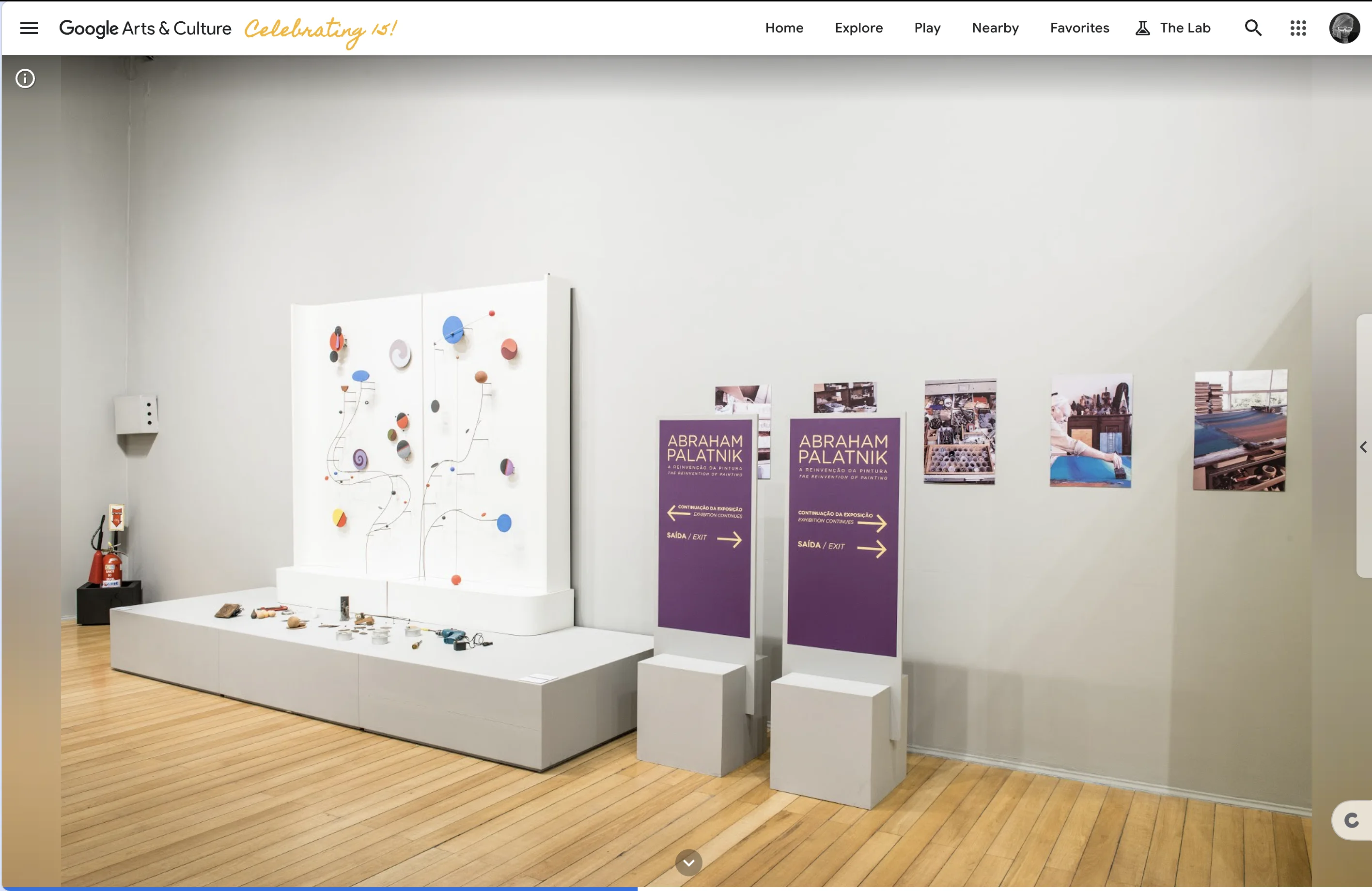
Two kinetic directions — and the distinction really matters
First: the Aparelhos Cinecromáticos, beginning around 1949
These are the Kinechromatic Apparatuses — motorized devices that produce changing compositions of colored light.
They are often built as boxes containing light bulbs, moving elements, a motor, and electrical or mechanical control mechanisms. The viewer sees an evolving luminous composition rather than the engineering that produces it.
The mechanics are largely hidden.
 Photo: MoMA source
What interests me here is the reversal of the usual relationship between a machine and an image.
A conventional painting is static: the color remains in place as time passes.
Palatnik builds an apparatus in which the image exists through time. The machine is not merely supporting the painting. The machine generates the painting.
Then: the Objetos Cinéticos, beginning in the 1960s
From around 1964, Palatnik develops Kinetic Objects where the construction becomes visible.
Instead of concealing everything behind a screen, he exposes arrangements of:
- fine metal rods,
- joints and pivots,
- geometric pieces,
- gears and transmissions,
- motors,
- painted wooden elements.
This seems like a major conceptual transition:
First, a machine that produces an image.
Then, a machine whose own body and movement become the image.
That is particularly relevant to the physical language I am trying to develop in Artificial Emotion.
 Photo: source
Now the motors. This is the part I really wanted to investigate.
I noticed what looks like a recurring mechanical vocabulary across Palatnik’s works, almost as if certain motor configurations and thin moving rods became part of his signature.
But we need to distinguish what is documented from what merely looks similar in photographs.
There is an especially valuable technical case study in the Getty publication Keep It Moving? Conserving Kinetic Art. Conservators investigated a 1962 Kinechromatic Apparatus in the collection of the Museum of Fine Arts, Houston.
They opened the work, examined its original construction, and documented the problems that appeared during conservation.

And here is a wonderful concrete detail:
One documented original motor: SAPMI Type 392 — 2 RPM
The conservators identified an original SAPMI Type 392, rated at 110 V and rotating at 2 revolutions per minute.
Two RPM.
I find this fascinating because it tells us something about the deliberate slowness of the experience. It is not a fast kinetic effect. A very slow motor can produce a constantly changing composition.
In this particular apparatus, the motor moved both cardboard paddles and a copper electrical contact comb involved in the lamp-control system.
When the original motor failed, replacing it was difficult. The conservators initially used a 24 V, 1 RPM motor, later returning the mechanism to 2 RPM with another replacement.
This is an excellent example of how conservation becomes a form of reverse engineering: understanding not only what the artwork looks like but what mechanical timing is necessary for it to behave as intended.
And there is an important limit to this finding: the SAPMI Type 392 is documented in this one work. We cannot conclude it was Palatnik’s favorite motor or that he used it across his entire practice.
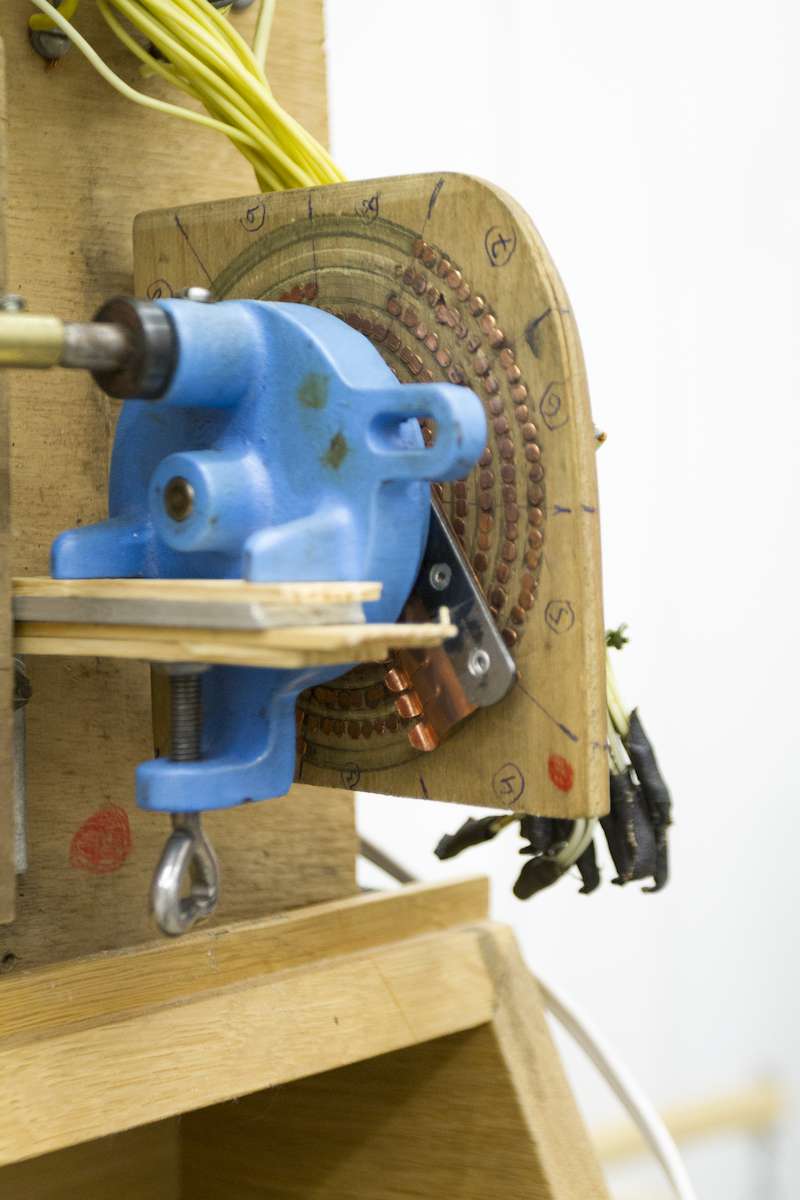 Photo: A detail of the interior of Abraham Palatnik’s Aparelho cinecromático (Chromo-kinetic set), 1962. source
What about the thin metallic rods? Are they aluminum?
That was my first question when looking at his Kinetic Objects.
Some of the thin rods look like aluminum in photographs. But the catalogue gives us more precise evidence for individual works.
For example, Objeto cinético P-4 (1966/2005) is catalogued as:
stainless steel, brass, painted wood, and motors.
So at least for this work, the answer is not simply aluminum.
That choice of materials makes sense mechanically:
- Brass can be useful for small rods and connections and is compatible with several soldering and brazing techniques.
- Stainless steel can provide rigidity for slender structural pieces.
- Painted wood can produce light, visually legible geometric forms.
- Motors, gears, and pivots can transfer movement through a composition without every element requiring its own actuator.
But I would be careful about one assumption: seeing a small metal connection does not prove it was soldered. It might instead use a mechanical joint, a press fit, a fastener, or another form of attachment.
The exact construction needs to be investigated work by work.
And he was not only making art. He also made furniture.
This is a detail that changes my understanding of him.
In 1954, Palatnik and his brother Aminadav founded Arte Viva, a modern furniture factory.
They produced tables, chairs, armchairs, and sofas — sometimes incorporating glass panels painted by Palatnik.
So he was not moving only between painting and kinetic sculpture. He was also engaged in industrial design and actual production.
This is not an insignificant side project. It suggests a practice in which the studio and the factory were not entirely separate worlds.
There is something here that reminds me of Munari, although their methods and aesthetic concerns were different: the question of what happens when artistic invention meets real materials, fabrication procedures, repeatability, and everyday objects.
What I find most important for Artificial Emotion
Looking at Palatnik’s mechanisms, I keep thinking that a complex experience does not necessarily require a complex mechanism.
A single slowly rotating motor can drive several elements through mechanical transmission.
The outcome depends not only on the motor, but on:
speed
linkage
geometry
phase
overlap
direction
repetition
time.
These seem like very productive questions for my own kinetic studies:
What happens when movement becomes extremely slow?
How can one motor distribute motion across several pieces?
What happens when the mechanism stops being hidden infrastructure and becomes part of the visual language?
And another comparison is emerging for me.
Calder works so beautifully with balance, gravity, pendulums, and air.
Munari investigates rules, simple mechanisms, chance, light, and the generation of perceptual states.
Palatnik goes deeply into motorized motion, mechanical transmission, light, and carefully composed changes through time.
Of course, these are not exclusive categories. They overlap. But as a way of organizing a study of kinetic mechanisms, the differences are extremely useful.
What interests me particularly is that the mechanism is not just there to animate something already designed. It determines which transformations are possible.
A static object is only one condition of a larger system.
And that connects strongly with Artificial Emotion: instead of building a sculpture that illustrates an emotion, what if I build a mechanism whose changing states make it appear to behave?
I also love the idea that Palatnik continued to think of his experiments in relation to painting. Even when he was building with gears, rods, lamps, and electric motors, he had not necessarily abandoned the pictorial problem. He had radically expanded its materials.
A small mental map
Abraham Palatnik — 1928–2020
Origins
→ Natal, Brazil
→ Jewish immigrant family from Eastern Europe
→ father Tobias and uncles involved in industry
→ childhood and adolescence in Palestine / Tel Aviv
→ engines, mechanics, drawing, painting
1940s
→ figurative painting
→ portraiture and still life
→ returns to Brazil in 1948
→ Almir Mavignier
→ Mário Pedrosa
→ Nise da Silveira / Engenho de Dentro
→ questions academic painting
1949–50s
→ Kinechromatic Apparatuses
→ concealed motors
→ moving light compositions
→ painting becomes temporal
→ furniture design / Arte Viva
1960s onward
→ Kinetic Objects
→ exposed rods and linkages
→ motors and gears
→ geometric forms
→ mechanical movement becomes visible
Recurring interests
color
light
motor
transmission
movement
time
perception
manufacturing
painting beyond the canvas.
Three references to keep close
- Abraham Palatnik — A Reinvenção da Pintura / The Reinvention of Painting — an exhibition catalogue with biography, historical images, and technical material descriptions. Catalogue PDF.
- Getty — Keep It Moving? Conserving Kinetic Art, especially the case study of the 1962 Kinechromatic Apparatus. A rare look inside the actual mechanical and electrical construction. Technical study.
- Abraham Palatnik — archival biography and historical context, including the family background and early technical education. OLATS biography.
I would like to continue from here with a very practical investigation: which of Palatnik’s Kinetic Object mechanisms could be reproduced as a small, low-cost physical study? I am especially curious about the rods, linkages, rotational speed, and how one motor distributes movement among several visual elements.
Sources
- Frederico Morais — Abraham Palatnik: A Pioneer of Technological Art. OLATS
- OLATS — Abraham Palatnik: Biographie complète. Archive
- Centro Cultural Banco do Brasil — Abraham Palatnik: The Reinvention of Painting. Google Arts & Culture
- Abraham Palatnik — A Reinvenção da Pintura / The Reinvention of Painting. Exhibition catalogue PDF
- Getty Conservation Institute — Keep It Moving? Conserving Kinetic Art, chapter 9, “Engineering a Solution”. Technical study
- Galeria Frente — Abraham Palatnik. Artist biography
- Galeria Nara Roesler — Abraham Palatnik Oficial Portfolio