From Sculpture to Kinetic Sculpture: Where Does the Machine Begin?
A short inquiry into how sculpture became a language of movement, and what distinguishes a kinetic sculpture from an automaton or a machine.
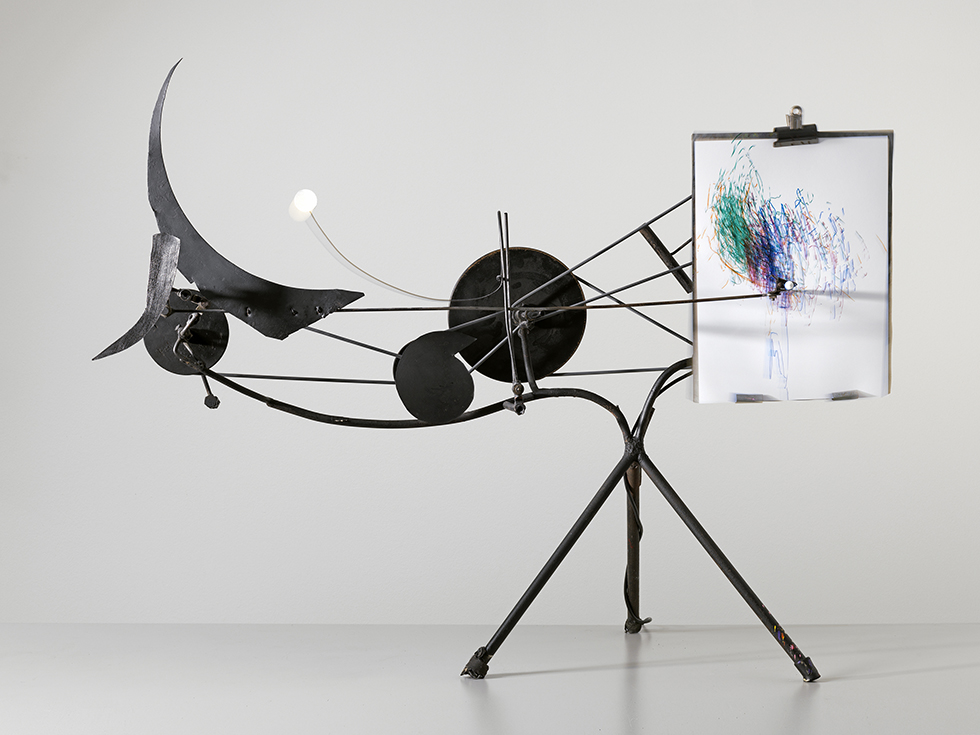
_Photo: Méta-Matic No. 10, 1959. source_
Before movement: what is sculpture?
The word sculpture comes from Latin sculpere, “to carve.” But three-dimensional objects existed long before sculpture became a distinct category of fine art. The prehistoric figures we now call sculptures were not necessarily made or understood as autonomous artworks. In antiquity, carving, modelling and casting belonged to different practices; during the Renaissance, sculpture increasingly gained recognition as an intellectual and artistic discipline alongside painting and architecture. By the eighteenth century, European systems of the fine arts had consolidated sculpture as a category.
This history matters because sculpture was never simply “a three-dimensional object.” Its definition has changed with the materials, techniques, institutions and questions through which objects are made and encountered.
When movement becomes form
A conventional sculpture may depict a moving body while remaining physically still. Kinetic sculpture asks what happens when actual movement participates in making the form.
In 1920, Naum Gabo's Kinetic Construction (Standing Wave) used a vibrating metal rod to produce the perception of a volume. The movement did not decorate a pre-existing shape; it generated the visible shape itself. In 1931, Marcel Duchamp gave the name mobile to Alexander Calder's moving constructions. Calder's later suspended mobiles made balance, gravity, air currents and material weight inseparable from composition. In 1955, the exhibition Le Mouvement at Galerie Denise René in Paris helped establish kinetic art as a recognized field.
These dates mark different developments: an early experiment with movement as form, a name for moving sculpture, and the wider recognition of kinetic art. They are not a single moment of invention.
_Photo: The Work of Naum Gabo, Nina & Graham Williams / Tate, London 2023. Source_
What is a machine?
A machine is an arrangement of parts that transmits or transforms forces, energy or motion. This is a mechanical description, not an artistic category. A rotating shaft, lever, cam or motor can belong equally to a clock, an automaton, a robot or a sculpture.
Automata long predate kinetic art: eighteenth-century mechanical figures, for instance, could reproduce writing, drawing or bodily gestures. Their movement was often organized around a recognizable performance. Yet the distinction is not absolute: automata can be sculptural, and sculptures can perform tasks.
The more useful question is not whether an object contains a mechanism, but what role the mechanism plays in the work.
Calder, Tinguely, and the machine as artistic language
Alexander Calder's mobiles, developed from the early 1930s, introduced a different relationship between sculpture and movement. Their forms emerge from the distribution of weight, the flexibility of materials, suspension and the forces acting upon them. Movement is neither an effect added to a completed sculpture nor simply the execution of a mechanical sequence. It is integral to how the work takes shape and occupies space.
In his 1946 essay _Les Mobiles de Calder_, Jean-Paul Sartre questioned whether Calder's work could even be understood within the traditional definition of sculpture. “Calder does not suggest movement, he captures it,” he wrote, contrasting the representation of movement in static materials with objects whose forms depend on actual physical events. Particularly revealing is Sartre's comparison with Jacques de Vaucanson's eighteenth-century automata: while the automaton reproduces recognizable gestures through precise mechanical sequences, Calder's mobiles hesitate, drift, respond to air currents and produce variations that cannot be fully anticipated. Sartre also acknowledges Calder's earlier use of electric motors. The distinction, therefore, is not simply between motorized and non-motorized objects, but between different ways of organizing and experiencing movement.
Jean Tinguely's _Méta-Matics_ (1959) complicate this distinction further. These motorized drawing machines perform a recognizable task, yet their mechanical operation, repetitive gestures, irregularities and interaction with viewers are inseparable from the resulting work. Rather than concealing the mechanism or presenting technological precision as an achievement, Tinguely exposes the machine as a system of production, introducing questions of authorship, automation and chance.
Calder and Tinguely thus offer two distinct approaches to the machine as an artistic language. In Calder, physical properties and environmental forces generate movements within a carefully constructed system of relationships. In Tinguely, mechanical operations themselves become subjects of artistic investigation. Neither approach can be reduced to the presence of a motor or to the absence of practical function. What matters is how the mechanisms, materials and conditions of movement participate in the conception of the work, rather than merely serving to animate it.
A question for Kinetic Studies
This distinction matters when I build kinetic experiments. A motor and a set of parts do not automatically produce a kinetic sculpture, just as a working mechanism is not automatically only a technical demonstration.
I am interested in the moment when the properties of materials, the design of connections and the qualities of movement become the subject of the investigation. A Calder mobile made of concrete would not simply be the same sculpture in another material: its balance, inertia, scale and response to air would change. Material is not an interchangeable shell around a mechanism.
Rather than draw a rigid boundary between automaton, machine and kinetic sculpture, I want to keep three questions open:
- What does the mechanism do?
- How do materials and forces shape its movement?
- What relationships does that movement create with its surroundings and the viewer?
The same motor may serve all three investigations. The artistic difference lies in what we choose to notice, construct and question.
References and further reading
- Naum Gabo, Kinetic Construction (Standing Wave) (1920), Tate: https://www.tate.org.uk/art/artworks/gabo-kinetic-construction-standing-wave-t00827
- Alexander Calder, Mobiles (from the early 1930s), Calder Foundation: https://calder.org/
- Le Mouvement, Galerie Denise René, Paris (1955).
- Jean-Paul Sartre, “Les Mobiles de Calder,” in Alexander Calder: Mobiles, Stabiles, Constellations, Galerie Louis Carré, Paris, 1946. English translation by Chris Turner (2008).
- Jean Tinguely, Méta-Matics (1959), Museum Tinguely: https://www.tinguely.ch/