Bruno Munari
1907–1998 · artist
An artist, designer and educator whose experiments with movement, machines, rules and perception offer a methodological reference for Artificial Emotion.

Photo: Bruno Munari surrounded by several of his works in 1967 Photo by Ugo Molas (source)
Bruno Munari — Context, Design, Machines, Books, and Movement
For me, the most interesting thing about Munari: he does not fit neatly into “designer,” “artist,” “writer,” or “educator.” He moved across all of these categories at a time when they themselves were still being invented and reorganized.
Bruno Munari lived from 1907 to 1998. He was born in Milan on October 24, 1907, but his childhood was not really Milanese. In 1913, when he was about six years old, his parents moved to Badia Polesine, a small town in Veneto, in northeastern Italy, where they began managing a hotel. So he grew up much more in the landscape of a small town and countryside than in the industrial metropolis with which we later associate him.
And his parents are a wonderful detail for understanding him. His father, Enrico Munari, was a head waiter / restaurant maître d’ in Milan and came from Badia Polesine. His mother, Pia Cavicchioni, embroidered fans.
That detail about his mother really catches my attention: Munari literally grew up with someone working with surface, pattern, repetition, color, delicate materials, and manual craft. I have not found serious biographical evidence saying “this is where his graphic work came from,” so I would not make that causal claim. But as material context for his childhood, it is fascinating.
He was not an architect
This is important: Munari did not have the typical training of many of the major Italian designers of the twentieth century, who came from architecture.
In fact, Treccani places him together with Marcello Nizzoli among the founders of an Italian lineage of “designer non architetti” — designers who were not architects.
After compulsory schooling, Munari went to Naples, where an engineer uncle directed him toward technical studies. In 1926, this uncle took him to Milan and employed him in his office as a graphic draftsman. Munari’s artistic training, however, was essentially self-taught.
So there is a very particular early mixture:
technical drawing + engineering by proximity + graphic work + self-taught art.
That seems to me a much better key to understanding him than saying “he studied design.”
And was “designer” already a profession?
Yes and no.
There were, of course, people designing industrial products, furniture, posters, publications, and objects. But the industrial designer as a clearly separated and institutionalized profession was only beginning to consolidate.
In Italy in the 1920s–40s, this territory was occupied by architects, artists, illustrators, typographers, advertisers, and progettisti. Munari himself worked professionally as a grafico long before he was celebrated as a “designer.”
In 1930, for example, he founded the R+M studio with Riccardo Castagnedi, known as Ricas, working with magazines, advertising, and visual communication. He even made campaigns for Campari. In 1938 he began working as a graphic designer for Mondadori.
So I would describe him like this:
Munari began professionally as an artist and graphic designer, and became one of the figures who helped define what would later be called Italian design.
That is different from saying “he trained as a designer.”
And he lived through both World Wars
He was born in 1907.
When World War I began in 1914, Munari was 6–7 years old. When it ended, he was 11.
When World War II began in 1939, he was 31–32 and already an established artist and professional in Milan.
And it is precisely during World War II that a huge part of his editorial work takes place.
He worked for Mondadori and directed the graphic/editorial area of Il Tempo. During the final years of the war, he took his family back to Badia Polesine for safety.
His son, Alberto, was born in 1940. And the arrival of his son seems to have been decisive for Munari’s interest in children’s books. Between 1940 and 1945 he began producing books in which he was not simply the “author”: he was simultaneously author, illustrator, and designer of the book-object.
That brings us to other question: Was he a writer?
Yes, he wrote a great deal. But I would not simply call him a writer.
Books are a gigantic part of his practice.
But Munari is not fundamentally working inside literature.
For him, the book is a communication machine.
Page. Paper. Hole. Transparency. Format. Sequence. Color. Typography. Texture. Cut. Fold. The rhythm of turning pages.
All of this produces meaning.
This is where things like the Libri Illeggibili — Unreadable Books, begun in the late 1940s, come from: books in which the material sequence itself replaces or nearly replaces textual narrative.
It is almost impossible to say whether what we are seeing there is:
- graphic design,
- sculpture,
- artist’s book,
- pedagogy,
- perceptual research,
- or visual literature.
The answer is: all of these at once.
And later he did indeed write important theoretical texts, including:
Arte come mestiere — 1966 (Design as Art in the English edition)
Design e comunicazione visiva — 1968
Codice ovvio — 1971
as well as Scoperta del quadrato, Scoperta del cerchio, Good Design, and many children’s and experimental books.
His youth is Futurist. That explains A LOT.
When he returned to Milan, at around 18–19 years old, Munari came into contact with what is known as Second Italian Futurism.
He began exhibiting with the Futurists in 1927. He moved in an environment influenced by:
Filippo Tommaso Marinetti Giacomo Balla Fortunato Depero Enrico Prampolini
and took part in Biennales, Quadriennales, and Futurist exhibitions throughout the 1930s.
This helps enormously in understanding his fascination with:
machine speed movement transformation technology typography advertising photography industrial objects.
But he does not simply remain “a Futurist.”
During the 1930s he gradually absorbed other influences: geometric abstraction, Constructivism, De Stijl, Bauhaus, Kandinsky, Mondrian, Moholy-Nagy, Man Ray, etc.
By around 1938, he was already formally moving away from Futurism.
In the postwar period, in 1948, he founded the MAC — Movimento Arte Concreta / Concrete Art Movement together with Gillo Dorfles, Gianni Monnet, and Atanasio Soldati, interested precisely in an abstract art that did not represent the world but produced its own relations among form, color, material, and space.
A simplified trajectory would look something like:
Futurism → abstraction/Constructivism → Concrete Art → kinetic/programmed art → design → pedagogy
Except that these things continue to coexist in him.
Now we come to the machines — and this is where I think we reach the Munari that matters enormously to Artificial Emotion.
Already around 1930, he made the Macchina Aerea.
From approximately 1930–33, the famous:
Macchine Inutili
Useless Machines
begin to appear.
And the name is a brilliant provocation.
They are not “machines that failed.”
They are machines deliberately freed from the obligation to produce something useful.
They are made with threads, rods, lightweight forms, cardboard, and similar materials. Suspended in space, they remain balanced and are moved by small air currents.

Photo: Useless Machine (Arrhythmic Carousel). source
There is a 1937 text by Munari that I think is particularly important for you. While describing these machines, he says that movement should be “the heart of the construction, the vital point.”
In other words:
movement does not decorate form. movement produces form.
That is an enormous distinction.
A Munari object at rest is not necessarily the complete work.
Form + balance + gravity + air current + time = work.
And this helps explain why you felt a connection with Artificial Emotion.
He explicitly thinks about TIME as a dimension of the work
Treccani records a formulation by Munari about the Macchine Inutili: they would represent a transition from figurative art in two or three dimensions toward a fourth dimension: time.
See how much this changes the reading.
It is not:
“I am going to make a sculpture and then put a motor in it.”
It is:
there is one configuration now; two seconds later it will be another.
Form becomes a temporary state of a system.
That feels incredibly contemporary.
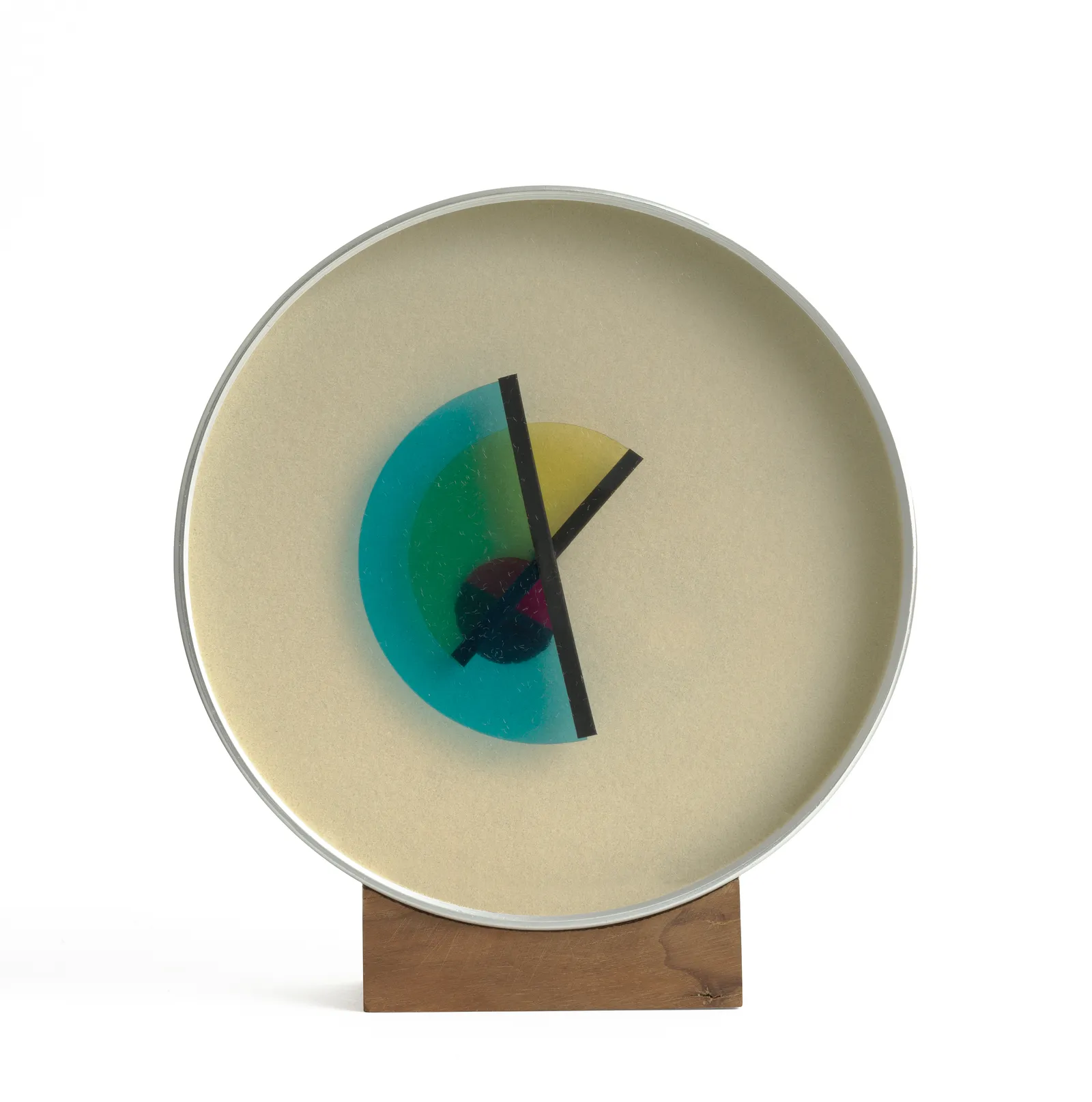 Photo: L’ora X, 1963 source
So why the clock?
Here too I think it is easy to interpret him incorrectly.
Munari does not seem to have developed a special interest in horology.
What seems to interest him is that the clock contains something extraordinary:
a mechanism that transforms time into predictable movement.
In 1945, he produced the prototype of the Ora X.
A conventional clock has hands whose job is to communicate the time.
Munari essentially asks:
what if I use that regular movement to produce color?
Instead of conventional hands, there are transparent colored half-discs. They rotate at different speeds and, as they overlap, continuously create new chromatic compositions.
The prototype used the spring mechanism of an alarm clock; later, in 1963, Danese produced a serial version in plastic/acrylic and aluminum. MoMA holds an example and classifies it in its Architecture and Design department.
So the Ora X is simultaneously a clock and a kinetic painting.
Or, even more beautifully:
the clock does not merely show time; it allows time to draw.
I think that is why it is so central.
And before that he had already written a Manifesto of Machinism
In 1938, Munari wrote the Manifesto del Macchinismo.
The idea, to summarize heavily, is not “let us worship machines.”
It is almost:
artists need to understand machines in order to appropriate them creatively.
Treccani directly connects this manifesto to the book Le macchine di Munari, published in 1942, filled with drawings of absurd and humorous machines.
This creates an interesting difference in relation to earlier Futurism.
The Futurist machine often appears as a symbol:
power → speed → industry → modernity.
In Munari it gradually becomes:
mechanism → rule → behavior → experience → play.
And that, for me, is one of the major shifts in his work.
 Photo: disegni di macchine inutili pubblicate sul libro Arte come mestiere, Laterza. source
And the graphic dimension is absolutely central
I might even go further:
Munari never abandons graphic thinking, even when he is making sculptures.
Look at a Macchina Inutile.
It is composed of:
circle rectangle line proportion color negative/positive.
Except now the graphic forms have left the page.
Then he adds:
depth + movement + shadow + time.
It is almost as if he were asking:
“what happens if an abstract composition leaves the page?”
The shadow of the machine on the wall produces another composition.
Rotation changes the overlaps.
The observer moves, and the composition changes again.
So graphics, sculpture, and kinetics become part of the same perceptual problem.
This appears explicitly in the text about the Macchine Inutili: he wants a fusion of sculpture, painting, and movement.
Another enormous thing in Munari is: RULES
This becomes even stronger after the war.
He begins to investigate systems in which you determine a few initial conditions and then allow variations to emerge:
positive-negative continuous structures polarized projections xerographies aritmie meccaniche Tetracono Flexy.
It is a way of thinking that today we would very easily call generative.
You do not necessarily design every final state.
You design the conditions through which states can appear.
This is why Munari speaks so well to:
creative coding, generative art, robotics, kinetic art, physical computing.
Even though he was born in 1907.
And there is yet another Munari: the educator
From the 1960s–70s onward, this becomes enormous.
He began developing workshop methods in which children discover the properties of materials and processes through experimentation.
In 1977, for example, he created children’s workshops in museums. Munari’s own archive places this among the central elements of his trajectory.
The logic is much less:
“make something beautiful like this.”
and much more:
“experiment with what this material can do.”
The teacher does not deliver a ready-made aesthetic.
The teacher provides:
material + procedure + constraint + question.
And that also helps explain the books.
The books do not simply want to transmit information.
They provoke investigation.
I would make this small mental map of him
Bruno Munari 1907–1998
origins → Milan → rural childhood in Badia Polesine → father connected to hospitality → mother embroidered fans → engineer uncle → technical studies / self-taught
1920s–30s → Futurism → graphic design → advertising → photography → abstraction → machines
1930–40 → Macchine Inutili → professional graphic design → Manifesto del Macchinismo → Mondadori → books
1940–50 → World War II / postwar period → children’s books → Ora X → Concavo-Convesso → Libri Illeggibili → MAC
1950–70 → kinetic art → polarized light → programmed art → industrial design → Danese objects → xerography → theoretical books
1970–90 → workshops → pedagogy → children → perception/material/process
And throughout all of this, the same things keep reappearing:
form color movement time machine rule chance perception humor play.
And there is something that I now consider much more important for Artificial Emotion than when we simply placed Munari on the list of references.
Calder is strongly working with balance, gravity, air, and organic movement.
Munari is deeply interested in a slightly different question:
how do you design a system in which a simple mechanical rule continuously produces different perceptual states?
In the Ora X, a banal clock mechanism produces a living chromatic composition.
In the Macchine Inutili, an air current continuously produces new relationships among forms.
In the polarized projections, a physical transformation produces color.
In programmed works, the rule does not determine a single image: it determines a field of possibilities.
This touches very directly on the question you are investigating in Artificial Emotion: not making a sculpture that represents an emotion, but creating a mechanism whose changing states make the object seem to be behaving.
And I think that is where Munari stops being simply a “historical reference for kinetic art” and can become a strong methodological reference for the project.
Sources
-
Treccani — Bruno Munari, Dizionario Biografico degli Italiani
https://www.treccani.it/enciclopedia/bruno-munari_%28Dizionario-Biografico%29/ -
Treccani — Cose belle e utili: la nascita del prodotto industriale
https://www.treccani.it/enciclopedia/cose-belle-e-utili-la-nascita-del-prodotto-industriale_%28Il-Contributo-italiano-alla-storia-del-Pensiero%3A-Tecnica%29/ -
Treccani — Bruno Munari, Enciclopedia Italiana
https://www.treccani.it/enciclopedia/bruno-munari_%28Enciclopedia-Italiana%29/ -
Treccani — Bruno Munari
https://www.treccani.it/enciclopedia/bruno-munari/ -
MunArt — Macchine Inutili
https://www.munart.org/index.php?p=21 -
MunArt — Bruno Munari, Le macchine inutili, La Lettura, 1937
https://www.munart.org/doc/bruno-munari-le-macchine-inutili-la-lettura-n-7-1937.pdf -
MoMA — Bruno Munari, Ora X
https://www.moma.org/collection/works/3696 -
Bruno Munari official archive / website
https://www.bruno-munari.com/