Ora X — Bruno Munari
Bruno Munari · 1945–1963 · artwork
A kinetic clock experiment in which transparent colored elements attached to a clock mechanism continuously generate new compositions through time.
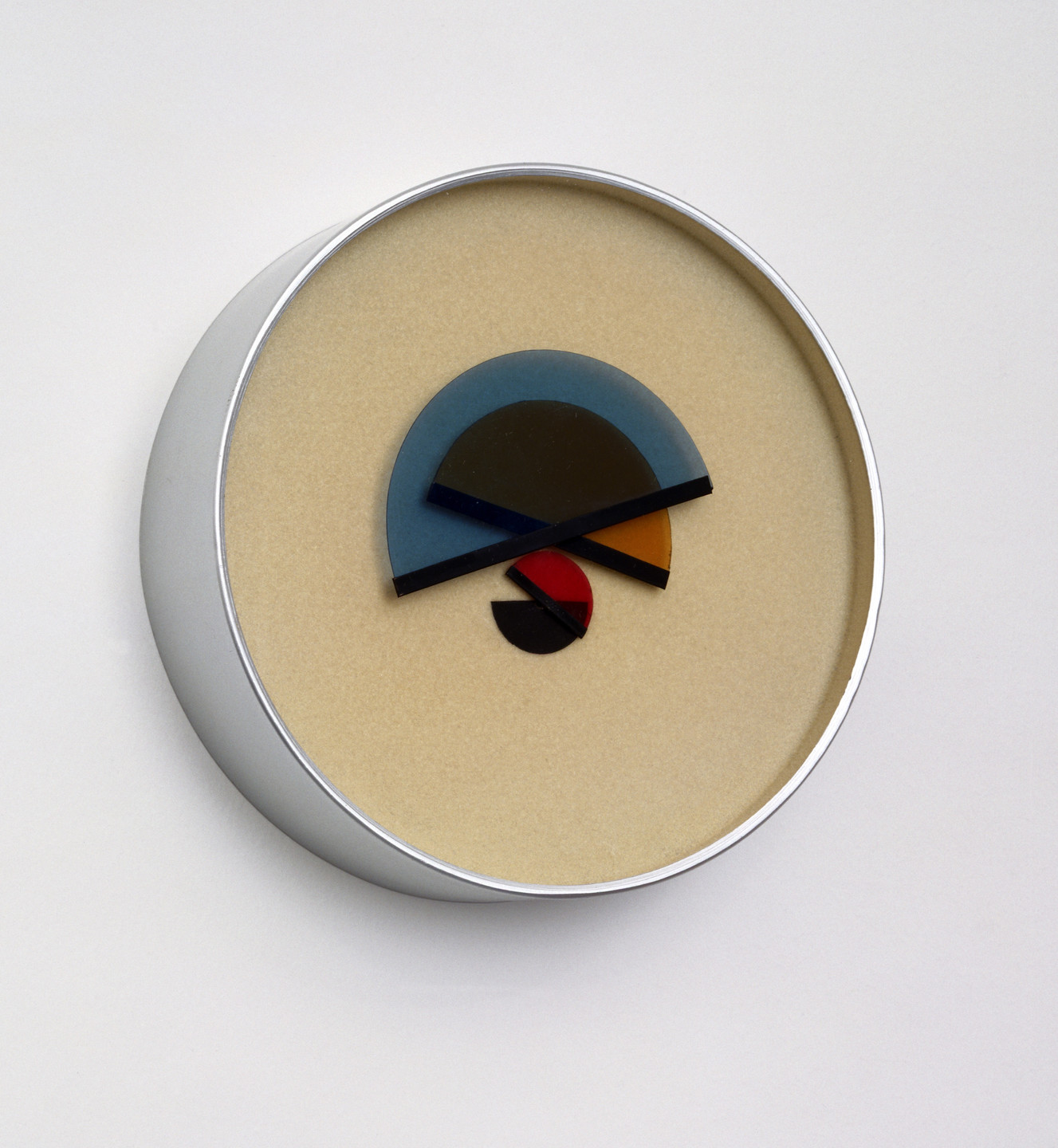
Image: MoMA collection image, 1963 Danese edition
Bruno Munari — Ora X
Metadata
- Artist: Bruno Munari
- Title: Ora X / L’Ora X / The X Hour
- Prototype: 1945
- Study model: after 1961, before 1963
- Edition: 1963
- Publisher / manufacturer: Edizioni Danese / Bruno Danese, Milan
- Edition size: 50
- Primary media of the 1963 edition: plastic, aluminum, spring mechanism
- 1963 edition diameter: approximately 20 cm
- Prototype media: modified enamelled-metal alarm clock, colored transparent elements, Perspex and wood frame
- Prototype dimensions: clock Ø 8 cm; frame approximately 20 × 20 × 8 cm
- Field: kinetic art, programmed art, design, artist multiple, clock
- Current status: distributed across a prototype, study material, a study model, institutional holdings, and individual examples from the edition of 50
Overview
Ora X is one of Bruno Munari’s clearest experiments in turning time into a generator of visual form.
Rather than using the clock only to indicate the hour, Munari attached transparent colored elements to moving clock hands. Because the different hands rotate at different speeds, the colored forms continuously overlap, separate, and recombine. The visual composition therefore does not exist as one fixed image: it is produced by the mechanism over time.
The work is particularly important because it exists across several categories at once. It is a functioning clock, a kinetic object, a color experiment, a prototype, a limited multiple, and a design object. Its development from a modified alarm clock in 1945 to a Danese edition of 50 in 1963 also makes it a useful case study for Munari’s interest in multiples, programmed variation, reproducibility, and the relationship between art and industrial production.
Munari later described the work in terms of a form growing mechanically through time, and of colors being born and disappearing as the elements overlap.
 Image: Centre Pompidou collection
The 1945 prototype
The first known Ora X was produced by Munari in 1945 as a unique experimental object.
The Fondazione Jacqueline Vodoz e Bruno Danese describes the prototype as an enamelled-metal alarm clock with an approximately 8 cm diameter, installed within a Perspex and wooden frame measuring about 20 × 20 × 8 cm.
The crucial intervention was simple: Munari transformed the clock hands into supports for transparent colored forms.
MunArt describes the prototype as using three transparent colored half-discs of different diameters, attached to the hands of an alarm clock. According to that account, the elements were flat colors—orange, yellow, and blue—combined with a fixed black semicircle on the white background. Their differing rotational speeds caused constantly changing superpositions.
Other documentary sources describe somewhat different color arrangements; these discrepancies are discussed below.
The important structural idea remains consistent across the sources:
the clock mechanism is not merely hidden machinery. It is the rule that generates the image.
The hands do not simply point toward numbers. Their relative velocities continuously change the relationship between transparent colored planes.
Why an alarm clock?
The prototype appears to have used an ordinary spring-driven alarm clock rather than a custom kinetic mechanism.
Munari takes an already standardized everyday machine with multiple coaxial motions and assigns those motions a second function. The device still measures time, but it also becomes a system for generating visual states.
 Image: Fondazione Jacqueline Vodoz e Bruno Danese — prototype in collection
MunArt — Ora X prototype and discussion: https://www.munart.org/index.php?p=21 https://www.munart.org/index.php?p=25
Preparatory studies and color experiments
There is evidence that Ora X was not simply an improvised modification made in one sitting.
MunArt reports a notebook dating from the 1930s–40s, now in the Bruno Munari collection of the Fondazione Jacqueline Vodoz e Bruno Danese, containing a drawing in which different color combinations are explored. Some of these variants were apparently never realized.
This matters because it shifts the interpretation of the object. The clock was not only a mechanical experiment; it belonged to a broader investigation into:
- flat color;
- transparency;
- superposition;
- changing chromatic combinations;
- movement;
- the generation of unpredictable or partially predictable visual states.
The mechanism establishes a strict rule, while the resulting color relationships continually change.
Image / archive reference
- MunArt discussion of the preparatory notebook and unrealized color variants:
https://www.munart.org/index.php?p=21 - Fondazione Jacqueline Vodoz e Bruno Danese archive overview:
https://www.fondazionevodozdanese.org/la-fondazione/
From prototype to multiple
The prototype remained a unique experimental object for almost two decades.
By the late 1950s and early 1960s, Munari was working closely with Bruno Danese and Jacqueline Vodoz, whose company Danese developed a distinctive model of publishing design objects, art editions, and research-based products.
The transition from the 1945 prototype to the 1963 edition is therefore not merely a change of material. It represents a change in the status of the work:
unique experiment → designed multiple
Munari later recalled that he had conceived Ora X with the ambition of turning it into a multiple and that Danese eventually realized this in 1963.
The Museum of Modern Art’s catalogue for the exhibition Multiples: The First Decade described Ora X as an object designed in 1945 for mass production and produced in 1963 as a multiple, in an edition of 50 published by Edizioni Danese.
The 1961–63 study model
Between the original prototype and the final Danese edition, there is surviving evidence of an intermediate development phase.
The Triennale di Milano / Giovanni Sacchi Collection holds a study model dated after 1961 and before 1963, attributed to Bruno Munari as designer and Giovanni Sacchi as executor.
The model is described as a table-clock study with:
- a low cylindrical body;
- a rectangular foot;
- a white clock face;
- a minute hand formed as a semicircular element;
- wood, plastic, glass, and sheet metal;
- dimensions approximately 200 × 60 × 210 mm.
This model is especially valuable because it documents the translation of Munari’s concept from a modified found object into an object designed for production.
Image / object reference
- Italian national catalogue — study model, Giovanni Sacchi / Bruno Munari:
https://catalogo.beniculturali.it/detail/Lombardia/HistoricOrArtisticProperty/3u020-00145_R03 - Lombardia Beni Culturali — study model:
https://www.lombardiabeniculturali.it/opere-arte/schede/3u020-00145/
The 1963 Danese edition
In 1963, Danese produced Ora X in an edition of 50.
According to MunArt:
- the modified alarm clock was replaced by a purpose-designed circular clock;
- the body became approximately 20 cm in diameter;
- the case was made from anodized aluminum;
- the conventional clock hands became visually subordinate to the transparent elements;
- the moving colored forms became the dominant visual language;
- the background changed from white to an ivory tone.
The work therefore becomes less recognizable as an altered domestic alarm clock and more like an autonomous kinetic composition.
A surviving exhibition checklist from the Fondazione Jacqueline Vodoz e Bruno Danese identifies two examples in the foundation collection as 1/50 and 47/50.
How Ora X works
At its simplest, the system consists of:
- a clock mechanism;
- several coaxial rotating axes;
- transparent colored elements attached to different clock hands;
- different rotational speeds;
- superposition.
Because hour, minute, and second motions operate at different rates, their relative angles continually change.
The resulting image can be thought of as:
visual state = f(hour angle, minute angle, second angle)
The work is deterministic in the sense that the clock mechanism follows fixed ratios, yet from the perspective of a viewer the number of possible intermediate combinations makes the composition appear continuously variable.
Munari is effectively designing a rule system rather than drawing every final composition.
Color, transparency, and superposition
Transparency is essential to the work.
If the moving elements were opaque, they would primarily conceal one another. Because they are transparent, overlapping elements produce new chromatic and geometric conditions.
The image emerges from:
- the individual color of each element;
- the changing geometric overlap;
- the optical result of superposition.
Munari’s interest is not simply in showing several colors moving independently. The overlapping zones create colors and shapes that do not belong to any one layer by itself.
Luca Zaffarano, writing on Munari’s continuously transforming forms, cites Munari describing Ora X as the time in which a color is born and later disappears, and as the mechanical growth of a form.
Time as a generative system
A conventional clock uses movement to communicate a measurement.
Ora X retains that mechanism but redirects attention away from numerical time and toward transformation.
The important question becomes not only:
What time is it?
but:
What form exists at this moment?
Each moment produces a temporary composition.
Rather than composing one final image, the artist establishes:
- components;
- constraints;
- velocities;
- relationships;
- a field of possible outcomes.
In contemporary terms, this can be understood as a form of physical generative design.
Relationship to Arte Programmata
Ora X predates the canonical moment of Arte Programmata by many years.
The prototype dates to 1945.
In 1962, Munari and Giorgio Soavi, with Olivetti’s support, organized the exhibition Arte Programmata, which brought together research in programmed, optical, and kinetic form.
The Danese multiple of Ora X appeared the following year, in 1963.
It would therefore be misleading to say that the 1945 prototype derived from Arte Programmata.
A better interpretation is that Ora X already contained several principles that later became central to programmed-art discourse:
- predefined rules;
- movement;
- variation over time;
- seriality;
- mechanical generation of form;
- an artwork understood as a system rather than a fixed composition.
Multiples and reproducibility
The edition of Ora X is important for understanding Munari’s distinction between an original work and a multiple.
The work is not fundamentally defined by a single handmade object. Its identity resides in a project, mechanism, material specification, and system of relations that can be reproduced.
Danese’s role is therefore close to that of a publisher.
The Fondazione Jacqueline Vodoz e Bruno Danese describes the company’s historical model as that of “Editori di Design” — publishers of design — working at the intersection of art, industry, objects, and serial production.
Related works
Macchine Inutili
The Macchine Inutili establish an earlier concern with form that changes through movement. Their motion often depends on air, balance, gravity, and suspended elements rather than clockwork, but the conceptual shift is related: the work cannot be reduced to a single static composition.
Proiezioni a luce polarizzata
Munari’s experiments with polarized light similarly use transparent materials, filters, rotation, and optical transformation to produce changing color relationships.
Arte Programmata — 1962
The exhibition provides an important theoretical and historical context for the programmed generation of visual states.
Tetracono — 1965
[source](https://vimeo.com/218525789)Tetracono develops programmed kinetic variation further. Four cones painted in contrasting colors rotate according to a mechanically defined system inside a cubic structure.
These works form a strong conceptual constellation around:
movement → rule → time → changing form
Reference links
- MunArt chronology:
https://www.munart.org/index.php?p=3 - Zaffarano, Bruno Munari. Creator of Forms:
https://www.munart.org/doc/bruno-munari-l-zaffarano-creator-forms-2018-en.pdf - David Reinfurt, c. 1962 / Meet the Tetracono:
https://www.munart.org/doc/bruno-munari-d-reinfurt-meet-the-tetracono.pdf
Known versions and collections
There is no single current “owner” of Ora X because the name refers to several related objects and to a numbered edition.
1945 prototype
Held by:
Fondazione Jacqueline Vodoz e Bruno Danese, Milan
1961–63 study model
Held by:
La Triennale di Milano — Giovanni Sacchi Collection
1963 multiple
The edition consisted of 50 examples.
Documented institutional holdings include:
Museum of Modern Art, New York
- Object number: 375.1963
- Department: Architecture and Design
- Credit: Greta Daniel Design Fund
- Manufacturer listed as Bruno Danese, Milan
- Medium: plastic, aluminum, spring mechanism
- Dimensions: 6.4 × 20 cm
- Listed as not on view
Centre Pompidou, Paris
- Inventory number: AM 2023-1-3
- Acquired in 2023
- Gift of the Amis du Centre Pompidou, Groupe d’Acquisition pour le Design
- Medium: plastic, aluminum, spring motor
- Dimensions: 22 × 20 × 6 cm
Fondazione Jacqueline Vodoz e Bruno Danese, Milan
A published exhibition checklist records at least two 1963 examples:
- 1/50
- 47/50
The remaining examples are distributed among public and private collections.
Documentary discrepancies
The surviving literature is not completely consistent about the prototype.
Colors
MunArt describes the 1945 object as having three transparent half-discs in:
- orange;
- yellow;
- blue;
plus a fixed black semicircle.
Zaffarano describes:
- yellow;
- red;
- blue.
A passage attributed to Munari describes two transparent half-discs—red and yellow—interacting with a red half-disc attached to the seconds hand.
David Reinfurt describes a prototype in which the hour, minute, second, and alarm hands carried four colors:
- yellow;
- blue;
- red;
- green.
These differences may refer to developmental states, archival reconstructions, or differing interpretations. The preparatory notebook also demonstrates that Munari tested color variants.
Until primary technical documentation is examined directly, the exact color assignment of every axis should remain an open question.
Date
Museums catalogue the work differently.
MoMA titles its example L’Ora X Clock. 1945, while also listing Bruno Danese as manufacturer and an acquisition/object number from 1963.
The Centre Pompidou uses the range 1945–1963.
The 1971 Multiples catalogue records 1945/63, distinguishing conception from production.
For research purposes:
- 1945 — prototype / original conception
- 1963 — Danese multiple
Process documentation
The surviving evidence currently identified includes:
- The 1945 prototype — Fondazione Jacqueline Vodoz e Bruno Danese.
- A notebook from the 1930s–40s — reported by MunArt as containing alternative color studies.
- The Giovanni Sacchi study model, c. 1961–63 — Triennale di Milano.
- Danese archival material — the foundation holds prototypes, sketches, project drawings, photographs, exhibition material, graphics, packaging, catalogues, and publications.
- Surviving 1963 edition examples — useful for comparison of materials, geometry, and mechanism.
A valuable future research step would be direct consultation of the Danese archive and the preparatory notebook.
Questions still worth researching
- What are the exact diameters of each transparent element in the 1945 prototype?
- Which color was attached to which clock axis?
- Did the alarm hand participate in the final 1945 configuration?
- What material were the first transparent elements actually made from?
- What exact clock movement was used in the 1945 prototype?
- What exact spring movement was used in the 1963 edition?
- Were the gear ratios or axes modified by Danese?
- Does the 1963 edition preserve hour, minute, and second functions conventionally?
- Are all 50 examples numbered and/or signed?
- Does the Danese archive preserve production drawings with layer dimensions?
- Are there surviving letters between Bruno Munari, Bruno Danese, Jacqueline Vodoz, and Giovanni Sacchi concerning the object?
- Can the preparatory notebook be consulted or reproduced in full?
- Are there sequential photographs or films showing a complete cycle of the object?
- How much visual variation occurs over 1 minute, 1 hour, and 12 hours?
- Are known edition examples mechanically identical, or were there production revisions?
Why Ora X matters for Artificial Emotion
For Artificial Emotion, Ora X is useful less as a visual style to imitate than as a methodological precedent.
The key principle is:
a simple mechanical rule can generate a continuously changing perceptual state.
Munari does not need a motor capable of sophisticated choreography.
He starts with a clock.
The mechanism already contains different temporal scales. By attaching visual information to those motions, he turns the clock into an image-generating system.
That is directly relevant to the current heartbeat slit animation study:
- the clock supplies a physical temporal rule;
- printed layers encode visual states;
- rotation reveals or combines those states;
- the apparent behavior emerges from the relationship between mechanism and image;
- the object can appear to “behave” without using a screen.
The most useful connection is therefore not:
Munari used transparent discs, so Artificial Emotion should use transparent discs.
It is:
Munari designed the conditions through which form changes over time.
For the heartbeat slit animation, the equivalent research question becomes:
What visual information should be encoded into the available mechanical motion so that a simple clock mechanism produces the perception of a living or emotional behavior?
Related project reference
/lab/heartbeat-slit-animation/
Sources
-
Fondazione Jacqueline Vodoz e Bruno Danese — Bruno Munari collection
https://www.fondazionevodozdanese.org/bruno-munari/ -
Fondazione Jacqueline Vodoz e Bruno Danese — Foundation and archive
https://www.fondazionevodozdanese.org/la-fondazione/ -
Fondazione Jacqueline Vodoz e Bruno Danese — History and mission
https://www.fondazionevodozdanese.org/storia-e-mission/ -
Fondazione Jacqueline Vodoz e Bruno Danese — Digital archive tools
https://www.fondazionevodozdanese.org/eng/strumenti-digitali/ -
MunArt — Un dinamismo a colori variabili ad un’ora X
https://www.munart.org/index.php?p=21 -
MunArt — Bruno Munari chronology / Ora X multiple
https://www.munart.org/index.php?p=3 -
MunArt — chromatic and multilayer research
https://www.munart.org/index.php?p=25 -
Luca Zaffarano — Bruno Munari. Creator of Forms
https://www.munart.org/doc/bruno-munari-l-zaffarano-creator-forms-2018-en.pdf -
David Reinfurt — c. 1962 / Meet the Tetracono
https://www.munart.org/doc/bruno-munari-d-reinfurt-meet-the-tetracono.pdf -
Multiples: The First Decade — catalogue entry for Ora X
https://www.munart.org/doc/bruno-munari-multiples-the-first-decade-1971.pdf -
Museum of Modern Art — Bruno Munari, L’Ora X Clock
https://www.moma.org/collection/works/3696 -
Centre Pompidou — Bruno Munari, Horloge Ora X
https://www.centrepompidou.fr/en/ressources/oeuvre/Rfck1nF -
Catalogo Generale dei Beni Culturali — Ora X, Giovanni Sacchi / Bruno Munari study model
https://catalogo.beniculturali.it/detail/Lombardia/HistoricOrArtisticProperty/3u020-00145_R03 -
Lombardia Beni Culturali — Ora X study model
https://www.lombardiabeniculturali.it/opere-arte/schede/3u020-00145/ -
Exhibition checklist documenting the 1945 prototype and 1963 examples 1/50 and 47/50
https://www.arapacis.it/sites/default/files/storage/original/application/bbcdca960f83948cc99a7ffc01a865ca.pdf