A Living Archive of Prototypes
A mobile, adaptable archive for the physical experiments of Artificial Emotion — designed to keep prototypes visible, accessible and part of an ongoing research process.
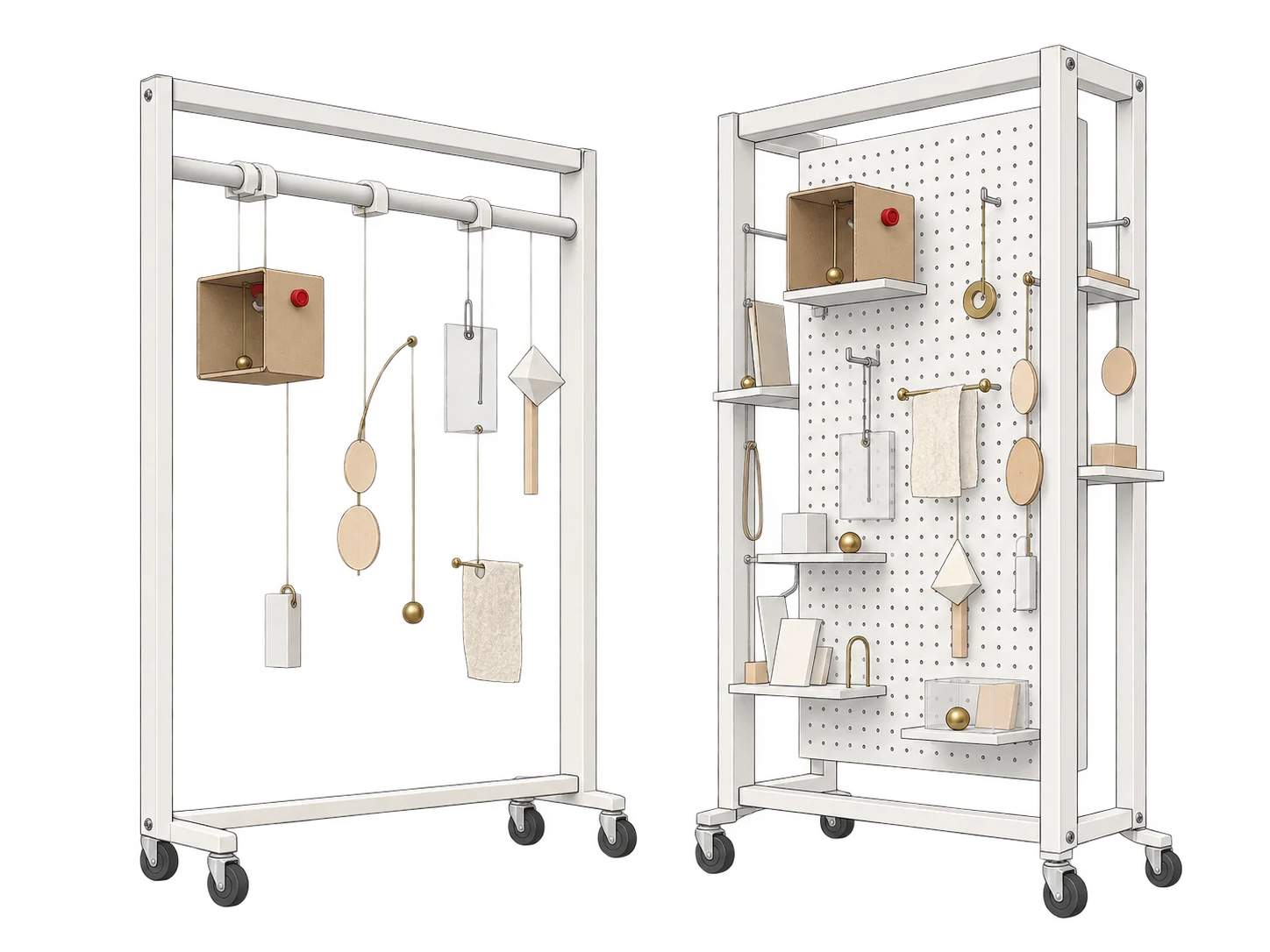
Prototypes accumulate
As Artificial Emotion develops, physical experiments begin to occupy the studio: small motors, suspended mechanisms, cardboard constructions, moving hearts, pieces of fabric, electronics and unfinished assemblies. Some work immediately. Others need to be taken apart, adjusted or rebuilt.
Their growing number creates a practical question. Where should these things live between experiments?
Conventional storage can protect an object, but it can also make the process disappear. Once a prototype goes into a box, it becomes harder to compare it with the next version, remember what it was testing or invite someone else into the investigation. A shelf, meanwhile, tends to favour finished-looking objects over provisional ones.
I began looking for a way to keep the research physically present without allowing it to take over the room. The aim was not simply to organise equipment, but to give unfinished work a visible place in the studio.
A mobile research archive
The idea that emerged was a living archive of prototypes: a lightweight, vertical and mobile structure that could hold experiments while leaving them easy to remove, rearrange, repair and demonstrate.
Movement matters here in more than one sense. The mechanisms themselves move, but the archive also needs to move around them. It should be possible to bring a group of experiments into a conversation, clear floor space for a workshop, or reposition the structure for documentation and public presentations.
Rather than fixing the research to a wall or building a permanent display, I wanted an arrangement that could change with the work. Both sides of a mobile frame might become usable surfaces. Different mechanisms might be suspended, clipped, hung or attached to a perforated panel. A prototype should not have to become a finished artwork before it can be shown.
The archive is therefore both storage and working exhibition infrastructure. It makes ongoing experiments available to be revisited, not just looked at.
Finding a structure
The search began with display systems, tool organisation, shelving and modular workshop furniture. The challenge was to find something stable and sufficiently neutral, but also affordable and easy to adapt without fabricating an entire structure from scratch.
I eventually chose two IKEA MITTZON mobile frames, approximately 85 cm wide, 50 cm deep and 205 cm high. Their open construction and wheels offered a useful starting point for a compact archive that could be reconfigured inside the studio.
The two frames have different proposed roles. One uses a 25 mm diameter horizontal rail to suspend kinetic modules, including small box-like constructions that contain motors and mechanisms. The other is intended to carry a perforated panel, creating a vertical surface for smaller studies, components, hooks and shelves.
What interested me was not the furniture as a finished product, but the possibility of treating it as an existing support structure — a frame onto which the research could gradually develop its own connections.
Adapting the structure
The first experiments made the limits of commercial furniture apparent. Hanging a cardboard prototype from the MITTZON rail required a connector. A custom 3D-printed U-shaped clamp offered a starting point, but testing a physical module on the rail revealed that the distance between the rail and the flat mounting surface mattered: too much clearance allowed the module to feel unstable.
Small observations like this are shaping the design. The connector has been revised with rounded corners, a regular mounting-hole pattern and a shorter U-shaped section. Instead of producing isolated brackets for each prototype, the intention is to develop a family of compatible parts around a shared construction grid. That technical investigation belongs to a separate study; here, its significance is that the archive is beginning to generate its own material language.
The perforated panel offers a different connection to an existing industrial vocabulary. Pegboard, widely used to organise tools in workshops, is inexpensive, replaceable and supported by commercially available hooks and holders. It is a familiar system that can be repurposed for displaying experiments rather than storing tools alone.
A white, 3 mm perforated hardboard sheet sold by JUMBO in Switzerland is the proposed surface for the second MITTZON. The measured perforation pattern is 25 × 25 mm between hole centres, with 4 mm diameter holes. Comparable 25 mm-pitch perforated hardboard is also sold in France, including by the French manufacturer Mottez. This suggests a useful degree of availability beyond a single local supplier, although dimensions, hole diameters and finishes vary between products.
The pegboard has not yet been mounted. For now, it represents the next step in the physical archive: combining readily available hooks and accessories with custom-made supports, while keeping the research's own connection system independent from the furniture and its commercial hole spacing.