Heartbeat & Biosignals
One heartbeat, many signals
An artistic research thread investigating the heartbeat as a coupled electrical, mechanical, acoustic and circulatory event — and how different ways of sensing it can become material for movement.
Research questions
- Q1
What are we actually sensing when we say we are measuring a heartbeat?
- Q2
How do different sensing methods transform the same cardiac event into different signals, rhythms and representations?
- Q3
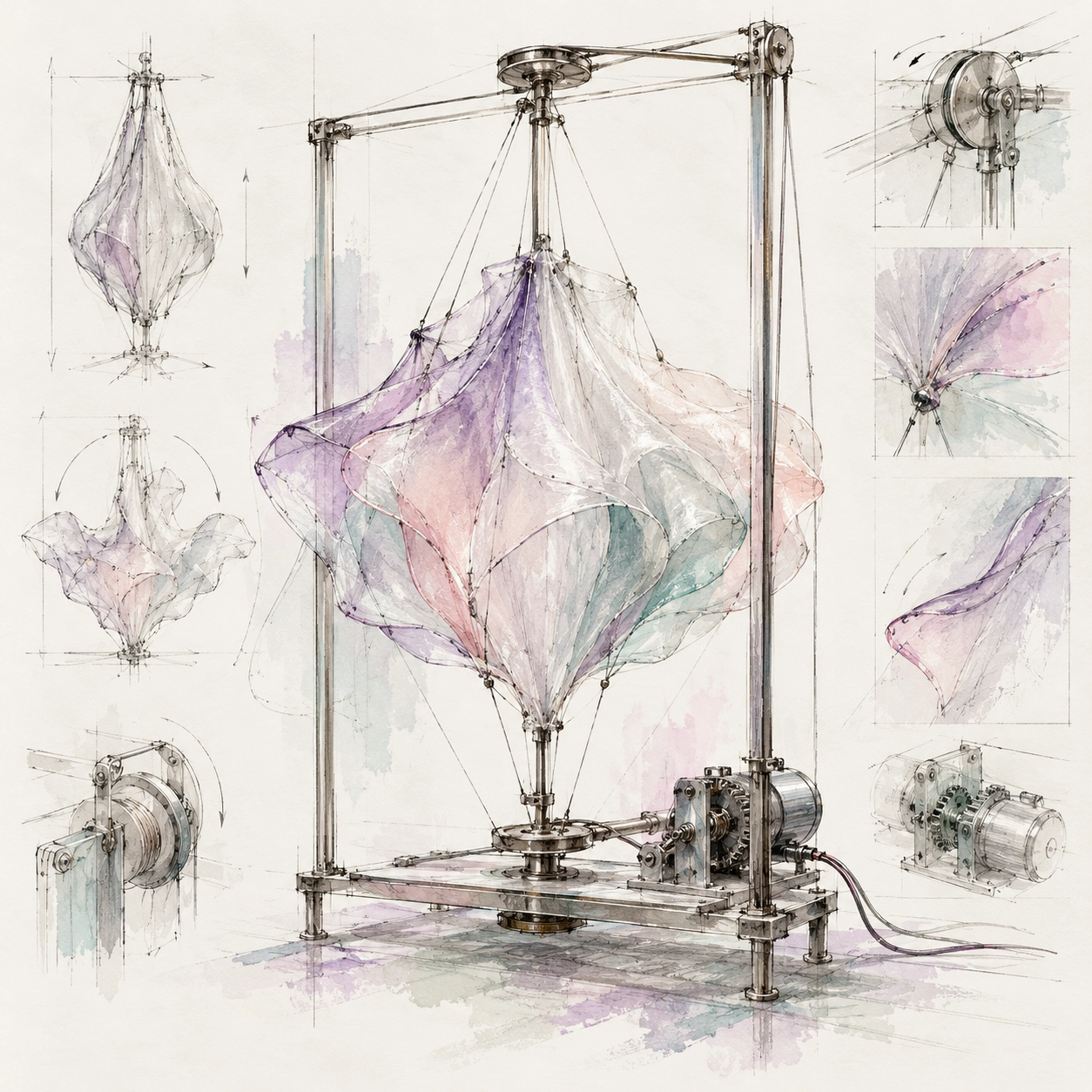
How can the pumping, twisting and releasing mechanics of the heart inform a kinetic body without simply imitating anatomical form?
Process
- Heartbeat
- Phenomenon
- Sensor
- Signal
- Behaviour

One heartbeat, many signals
A heartbeat is not one signal.
It is a chain of connected physical events that can be observed from different points: electrical activation, muscular contraction, pressure change, blood displacement, pulse propagation, vibration, sound and visible motion.
Each sensing method encounters that event differently.
An ECG does not measure the same thing as a stethoscope.
A smartwatch does not see what an echocardiogram sees.
A finger placed over an artery does not receive the same information as an electrode placed on the skin.
All of them can be described as measuring the heartbeat, but each one constructs a different version of it.
This is the starting point of Heartbeat & Biosignals:
one physiological event can become many different signals depending on where, how and with which instrument we listen.
What are we measuring?
The research begins by separating phenomena that are often collapsed into the single idea of “heart rate”.
Electricity
Electrocardiography — ECG / EKG
Electrodes on the skin detect changes in electrical potential associated with the electrical activation of the heart.
The ECG therefore observes the electrical organisation that precedes and accompanies contraction.
From this signal it is possible to identify rhythm and timing between beats, but the electrical trace is not the mechanical contraction itself.
Sound
Stethoscope / phonocardiography — PCG
The beating heart produces vibrations that travel through the chest.
A stethoscope listens to them.
A phonocardiogram records them as a signal.
The familiar heart sounds are connected to mechanical events in the cardiac cycle, particularly changes in pressure, valve motion and vibrations produced by the heart and moving blood.
For this research, sound is especially interesting because it turns an internal mechanical event into something already rhythmic and perceptible.
Blood volume and pulse wave
Photoplethysmography — PPG
PPG uses light and a photodetector to observe pulsatile changes in blood volume in tissue.
This is the principle behind many smartwatches and pulse oximeters.
The sensor is not directly watching the heart contract. It is detecting a vascular consequence of that contraction after the pulse has travelled away from the heart.
This delay and translation are important.
The heartbeat becomes light reflected from skin.
Pressure
Blood-pressure cuff / pressure sensing
The cardiac cycle generates changing pressure in the arterial system.
A cuff or pressure sensor encounters the heartbeat through these pressure variations.
Again, the same event appears through another physical consequence: not electricity, sound or light, but force acting through blood and vessel walls.
Touch
Palpation
The pulse can be sensed mechanically with the hand.
Touch provides rate and rhythm, but also qualities that are difficult to reduce to a single number: strength, regularity and the felt character of the pulse.
This is one of the simplest sensing systems in the research.
The body itself becomes the sensor.
Motion
Echocardiography
Ultrasound makes it possible to observe the heart as a moving structure.
Instead of reducing the cardiac cycle to a line graph, echocardiography can show chambers, walls and valves changing through time, while Doppler techniques can also visualise aspects of blood flow.
This is important for Artificial Emotion because it makes the heartbeat visible as deformation and motion.
The heart is not only a metronome.
It changes shape.
The heart as a twisting pump
The mechanical action of the heart is more complex than a simple squeeze.
The muscle fibres of the ventricular wall change orientation through its depth. In the left ventricle, these changing fibre directions contribute to a twisting motion during contraction and an untwisting or recoil during relaxation.
This gives the pumping action a quality closer to wringing, twisting and releasing than to the opening and closing of a simple bellows.
For the research, this matters because it changes how a kinetic heart might be imagined.
A mechanical heart does not need to reproduce a literal anatomical organ.
It can investigate principles:
- twisting
- shortening
- thickening
- compression
- recoil
- release
- filling
- rhythmic repetition
The idea of a helical cardiac architecture is therefore useful here as a mechanical and sculptural reference.
At the same time, I do not want to reduce the anatomy to the claim that the ventricle is one single separable “helical band”. The exact anatomical model is debated. What is useful for this research is the broader and well-established relationship between changing myocardial fibre orientation and ventricular twist.
Heartbeat as translation
Each sensor creates a translation.
Electrical activation → voltage trace
Cardiac vibration → sound waveform
Blood-volume change → optical waveform
Arterial pressure → pressure waveform
Pulse at the skin → tactile event
Cardiac deformation → moving image
None of these is the heartbeat in its entirety.
Each is a partial observation.
This makes biosensing interesting artistically.
A sensor is not simply a neutral device that reveals the body. It selects a phenomenon, a position, a scale and a form of representation.
The same living event can therefore become a line, a sound, a flash of light, a number, an image or a mechanical command.
From signal to movement
Artificial Emotion introduces another translation:
a physiological signal becomes mechanical behaviour.
A measured heartbeat might control:
- the timing of a contraction
- the interval between movements
- the amplitude of a pull
- the speed of a motor
- the tension of a textile structure
- the relationship between several kinetic modules
- a delayed or distorted mechanical echo of the original beat
The objective is not necessarily to make a machine copy the human heartbeat accurately.
The more interesting question is what happens during translation.
What is lost?
What becomes exaggerated?
What begins to look emotional?
A regular biological pulse may become an irregular mechanical gesture because of friction, inertia, elasticity, gravity or material resistance.
The body produces a signal.
The sensor interprets it.
The mechanism interprets it again.
Current sensing experiments
This thread develops through comparative experiments rather than through one privileged sensor.
One current direction is acoustic capture.
I have been developing a simple phonocardiogram experiment using a piezoelectric element, a small acoustic chamber and amplification electronics. The objective is to understand how much of the mechanical vibration of the heart can be captured with accessible materials, and what happens to that signal as it moves through contact surfaces, chambers, tubing and amplification.
Another direction is optical pulse sensing, including PPG systems in which an LED illuminates tissue and a photodetector reads changes associated with pulsatile blood volume.
These experiments are useful precisely because they do not produce identical representations.
Comparing them makes the measurement itself visible as part of the artwork.
A history of bodies and signals
Heartbeat & Biosignals continues a longer line in my practice in which biological bodies are never treated as transparent sources of data.
In Touch Skin, the skin became part of an electrical circuit.
In My Medical Bodies, menstrual blood and medical representation became a way to question the gap between a living body and the ways institutions describe it.
In Creativity in vitro, developed with Eduardo Padilha, EEG signals, machine learning and neural organoids became tools for asking how imagination might be measured, translated and inferred.
These projects differ technically, but they share a concern:
what happens when a living process becomes a signal?
Artificial Emotion brings that question back into the physical world.
Instead of translating a biosignal only into data, text or visualisation, the signal can return to matter as movement.
Heartbeat studies
This research thread is intended to grow through multiple Studies.
A Study may focus on only one layer of the cardiac event:
- listening to heart sounds
- comparing piezoelectric contact points
- optical pulse sensing at the finger or wrist
- pulse detection using a phone camera and light
- comparing ECG and PPG timing
- translating pulse intervals into motor movement
- visualising cardiac twist
- constructing a twisting or contracting kinetic heart
- comparing biological rhythm with mechanical repetition
- introducing latency, noise and error into the translation
- testing what happens when one person's heartbeat drives another physical body
The studies do not need to agree with one another.
They are different ways of approaching the same event.
Connection to Artificial Emotion
Heartbeat & Biosignals gives Artificial Emotion a living temporal reference.
Soft Mechanics asks how a textile can become a mechanical body.
Kinetic Studies asks how movement becomes behaviour.
Heartbeat & Biosignals asks what happens when that behaviour is connected to a physiological rhythm.
The heartbeat is especially charged because it exists simultaneously as physiology and metaphor.
It pumps blood.
It generates pressure, motion, sound and pulse.
And culturally, it is constantly used as shorthand for emotion, life, fear, intimacy and desire.
Artificial Emotion does not need to accept that metaphor uncritically.
Instead, the research can dismantle it:
measure the heart in different ways,
separate its signals,
translate them,
distort them,
and rebuild them as mechanical behaviour.
The heartbeat is not one signal. It is a living event observed through many instruments.
Studio Notes
 infrastructureA Living Archive of PrototypesA mobile, adaptable archive for the physical experiments of Artificial Emotion — designed to keep prototypes visible, accessible and part of an ongoing research process.
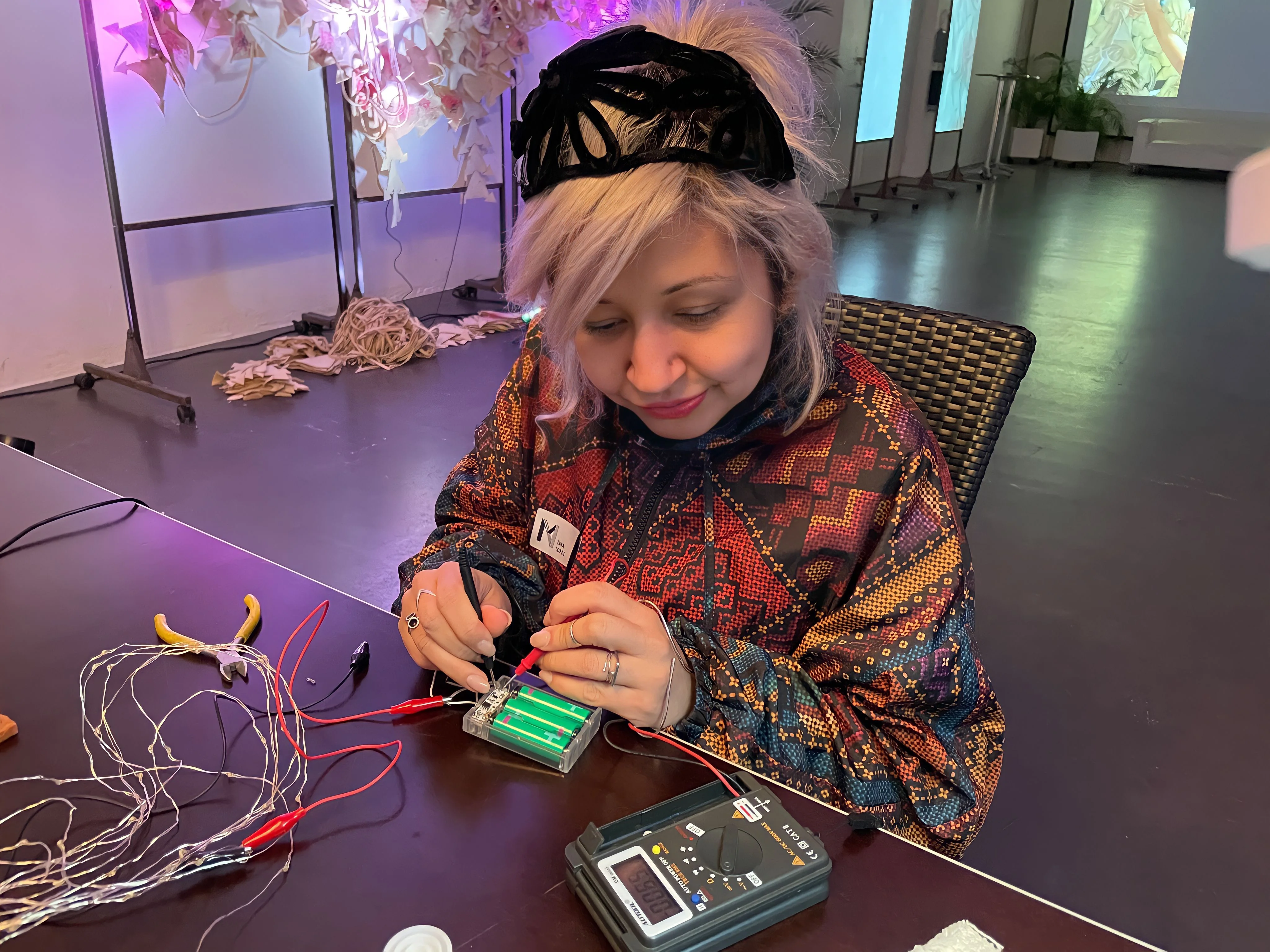 personLina LopesBrazilian artist, creative technologist and educator based in Switzerland, working across kinetic systems, physical computing, artificial intelligence, interactive environments and experimental forms of learning.
 institutionSchool of Tomorrow's AIAn independent art, technology and creative-learning initiative founded by Lina Lopes in Wetzikon, Greater Zurich — and the main Swiss research base of Artificial Emotion.