Lina Lopes
Brazilian artist, creative technologist and educator based in Switzerland, working across kinetic systems, physical computing, artificial intelligence, interactive environments and experimental forms of learning.
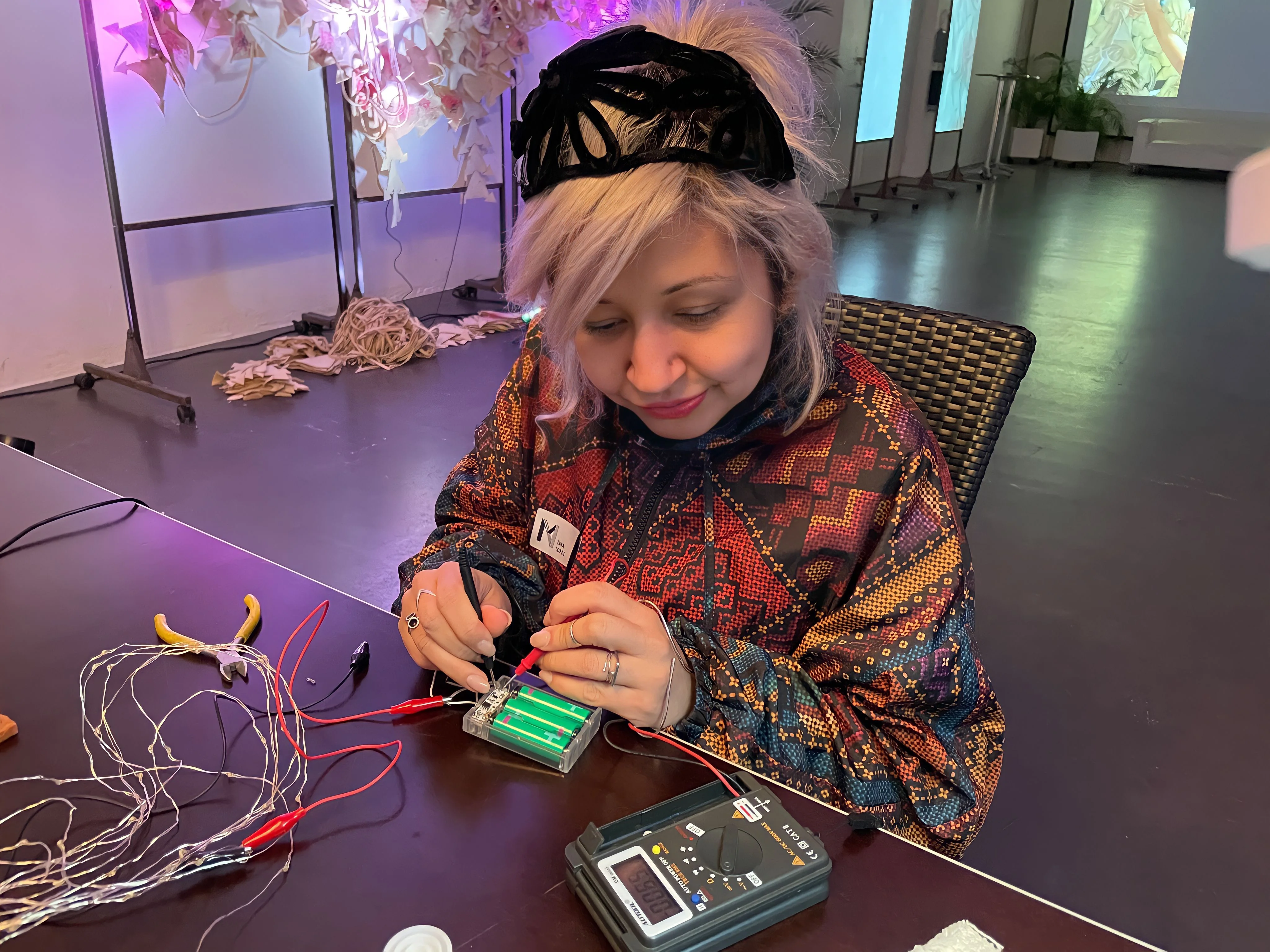
About
I am a Brazilian artist, creative technologist and educator based in Switzerland.
My practice moves between art, technology, research and learning. I work with physical computing, kinetic systems, artificial intelligence, sensors, interactive environments, soft materials and creative coding, often building situations in which technology is experienced through bodies, movement and material behaviour rather than through screens alone.
I am interested in what happens before a technological object becomes stable: the prototype, the test, the failure, the improvised mechanism, the question that still does not have a clear answer. Much of my work develops through these unfinished states.
Practice
My background crosses artistic practice, design, technology and computation.
Over the years, I have worked with interactive installations, wearable electronics, e-textiles, physical interfaces, data and machine-learning systems, creative coding, video mapping, biodesign and experimental fabrication.
Rather than treating these as separate disciplines, I tend to use them as a shared toolbox. A project may begin with a bodily gesture, move into electronics, become a software experiment, return as a mechanical prototype and eventually become an installation, workshop or public research format.
This way of working has also shaped my interest in creative technology as a field: not simply the application of technical tools to artistic ideas, but a practice in which making changes the question itself.
Artificial Emotion
I am developing Artificial Emotion as an ongoing artistic research project around movement, soft mechanisms, sensing and bodily signals.
The project asks how a machine can acquire expressive behaviour without simply imitating a human face or performing a predefined emotion. Instead, I am looking at physical qualities such as tension, contraction, hesitation, trembling, release, rhythm and repetition — and at the point where a viewer begins to interpret those behaviours emotionally.
The work develops through small studies, dirty prototypes, material experiments, kinetic mechanisms and sensing tests. Some studies may become parts of a larger installation; others remain as evidence of a question that was useful to pursue.
Artificial Emotion is also becoming a framework through which different parts of my practice can meet: kinetic sculpture, textiles, electronics, physiological sensing, creative coding, teaching and public experimentation.
Working between Wetzikon and Paris
The main Swiss base of the research is School of Tomorrow's AI in Wetzikon, in the Greater Zurich area.
I founded the School as an independent initiative for AI for Creative Practices, physical computing and experimental learning. Its studio at the historic Schönau-Areal has gradually become both a teaching environment and a research space, where prototypes can remain visible, unfinished and available for conversation.
I am also an institutional Artist-in-Residence at the Institute for Future Technologies (IFT), De Vinci Higher Education, in Paris. My relationship with IFT grew from teaching and prototyping with Creative Technology students around the theme Sensitive Machines, an experience that became one of the starting points for Artificial Emotion.
Working between these two contexts allows the project to move between an independent studio in Switzerland and an academic research environment in Paris.
Learning as part of the practice
Teaching is not separate from my artistic work.
I have developed workshops, curricula and learning experiences around artificial intelligence, physical computing, biodesign, creative coding and experimental making. My approach is strongly based on making first: putting something physical into the world quickly enough that it can be observed, criticised and changed.
I often describe this as a Dirty Prototype approach.
The prototype does not need to prove that an idea works. It needs to make the question tangible.
This methodology moves in both directions. Workshops generate observations that return to the studio, while artistic research produces methods, exercises and technical experiments that can later become learning formats.
School of Tomorrow's AI is where these two sides of the practice increasingly meet.
Current context
I am currently based in Switzerland and developing a research-led phase of my practice centred on kinetic art, embodied interaction and experimental approaches to artificial intelligence.
Artificial Emotion sits within this broader transition: from individual interactive works toward longer research processes in which artworks, studies, workshops, collaborators, institutions and public documentation form a connected ecosystem.
This digital notebook is part of that process.