Studyexperiment
Counterweighted Textile Mechanism
Two pulley circuits and a suspended organza tube
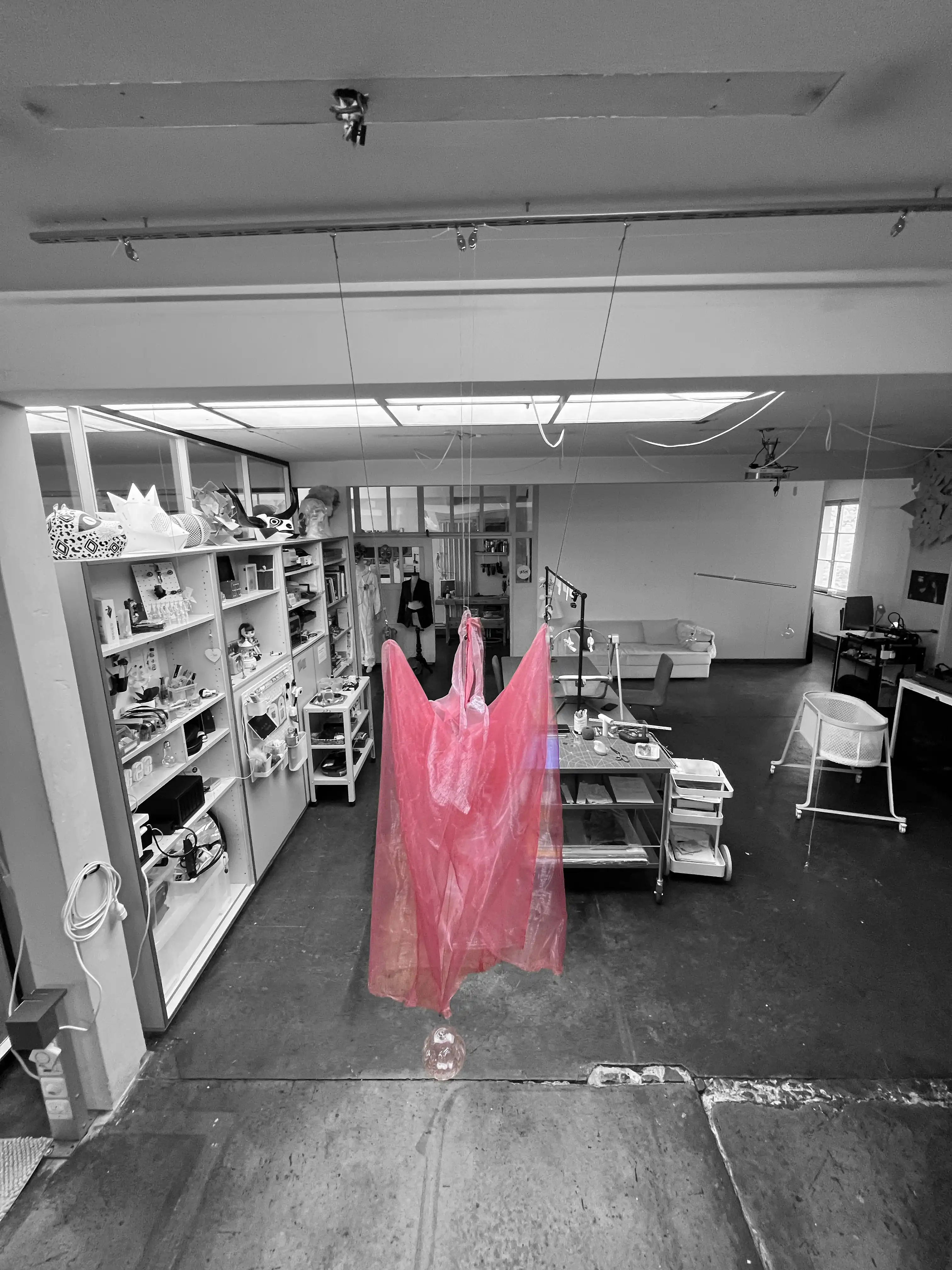
An experimental organza structure uses two independently routed pulley-and-counterweight lines, a fixed waist, and an adjustable link between its moving upper and lower sections to explore textile contraction and expansion.
Question
Question
How can a three-dimensional textile form be brought into motion using simple mechanical systems?
Within _Artificial Emotion_, this question emerges from the development of an organza heart: a soft, volumetric structure whose shape could change through contraction, expansion, and the redistribution of tension.
This study investigates how gravity, pulleys, counterweights, and adjustable connections can animate a lightweight textile structure without motors. Rather than moving the entire object as a rigid body, the aim is to explore how mechanical forces can transform its volume, silhouette, and internal folds.
Setup
The structure consists of a horizontal support, two pulleys (one on each side), and a translucent tube of red organza. The two pulley lines are independent in routing but mechanically coupled through the textile.
- Left / orange circuit: a cord runs over the left pulley to the movable upper section of the organza tube. The line can be pulled to change the upper section's position.
- Right / purple circuit: a second cord runs over the right pulley and acts on the lower section of the tube.
- Fixed waist: the central waist is held at exactly two fixed suspension points, one on each side. It is a stationary reference between the two moving sections, not a third moving suspension.
- Adjustable connection: the upper and lower sections are connected to one another by cords. Changing their length is part of the experiment and affects how the textile responds to either circuit.
- Glass sphere: a glass ball was added as a weight in the assembly, introducing a further gravitational influence.
I arranged the two pulley systems on opposite sides of the textile structure to make their force paths easier to distinguish and experiment with. This configuration allows the upper and lower sections to be manipulated separately while remaining mechanically connected through the textile.
Mechanism diagram — two independent pulley routes, two fixed waist supports, and the adjustable link between the moving ends. Diagram: Artificial Emotion research documentation.
Observation
The structure does not behave like an ordinary curtain being raised and lowered. The fixed waist divides the textile into two deformable regions. Pulling at the upper or lower section changes the distribution of folds and tension, while the connecting cords transmit some of that movement to the other region. The material gathers, releases, and changes silhouette as the system is operated.
The relationship between the upper and lower movements is sensitive to the length of the connecting cords. Varying this distance is a particularly promising next experiment: it may change when the second region begins responding, how much fabric collects near the waist, and how strongly the upper and lower deformations appear coupled. These effects still need systematic testing.
This is an initial kinetic study, not yet a measured demonstration of a particular displacement ratio or of self-sustained motion. Gravity supplies force through the weights, but repeated cycling would require resetting or otherwise supplying energy.
Movement documentation
A short history of moving scenery
The use of suspended loads and mechanical movement in performance predates the modern stage. In fifth-century BCE Greek theatre, the mēchanē was a theatrical lifting device that could bring gods or heroes into view above the stage. Its association with divine intervention is the origin of the expression deus ex machina — the god appearing through a machine. Reconstructions often propose a pivoted beam, possibly counterweighted, but the exact mechanical arrangements remain uncertain.
Centuries later, Renaissance and Baroque theatre developed increasingly elaborate ways to move scenery, clouds, performers, and architectural illusions. In the seventeenth century, the Italian stage engineer Nicola Sabbatini documented techniques of scenic machinery in Pratica di fabricar scene e machine ne' teatri (1637–1638). Giacomo Torelli, working in the 1640s, became known for coordinated scene changes in which several pieces of scenery moved together using linked mechanical systems. These inventions built on earlier theatrical practices rather than springing from one inventor.
This history suggests a useful distinction. Theatrical rigging often hides the mechanism so that the audience sees an apparent miracle. In this textile study, the cords, weights, and changing distribution of tension can themselves become visible elements of the work. Instead of concealing how a scene moves, the sculpture can make mechanical causality part of what is perceived.
Historical sources
- The Metropolitan Museum of Art, Theater in Ancient Greece — overview of the mēchanē and its theatrical role.
- Tatiana Bur, Viewing the Mēchanē (2025) — historical interpretation of the Greek theatrical crane and its material effects.
- Nicola Sabbatini, Pratica di fabricar scene e machine ne' teatri (1637–1638) — an early treatise on theatrical scenery and machinery.
- Staging and Stage Décor — background on seventeenth-century scenic transformation and Torelli.
Next
- Test different lengths of the internal connections between the upper and lower sections. Record how each length changes the sequence and extent of folding.
- Compare the response of red organza and tulle under the same routing and approximate loads.
- Replace temporary hand-pulling with adjustable, visually considered weights; measure the minimum mass difference necessary to initiate movement.
- Document both extreme configurations and one intermediate position from a fixed viewpoint, including the movement of each weight.
- Experiment with alternative pulley arrangements and counterweight positions, observing how the routing affects the movement, balance, and spatial composition of the textile structure.
The intention is not simply to make fabric rise and fall, but to investigate how gravity and mechanical tension can give a soft, three-dimensional textile form a movement that suggests breathing, contraction, or other bodily behaviours.