Alexander Calder
1898–1976 · artist
An American sculptor and inventor whose wire circus, motor-driven abstractions and suspended mobiles transformed movement, balance, gravity, air and time into sculptural materials — a historical and methodological reference for Artificial Emotion.

Photo: Alexander Calder, historical photograph (1947), Calder Foundation.
Alexander Calder — From the Circus to Motor-Driven Machines and Suspended Mobiles
What fascinates me about Alexander Calder is that he did not begin by trying to make elegant hanging sculptures that move in the wind. He made toys, small constructions, wire portraits, and an entire miniature circus that he personally performed for audiences. Only later did movement become the subject of abstract sculpture: first through manually operated mechanisms, then through electric motors, and finally through the balance of suspended elements responding to air currents.
The trajectory is particularly relevant to Artificial Emotion: how does a physical mechanism become expressive? What makes an object appear hesitant, playful, delicate, purposeful, or almost alive, even though its behavior is produced by ordinary physical forces?
Three overlapping identities offer a way into Calder’s work: builder, performer, and sculptor.
First, he was American — not French
Alexander Calder was born in Philadelphia, Pennsylvania, in 1898 and died in New York in 1976. He was an American artist who lived and worked extensively in France. Paris was crucial to his artistic transformation, especially from 1926 through the early 1930s, and he later maintained a home and studio in the French countryside.
Calder’s mobility between the United States and Europe was not incidental. He worked within artistic communities on both sides of the Atlantic, exhibited internationally, and met artists who would help him think beyond representational drawing and sculpture.
An artistic family — and an engineer’s education
Calder grew up in a family where making art was an established profession:
- His father, Alexander Stirling Calder, was a sculptor known for monumental and public commissions.
- His paternal grandfather, Alexander Milne Calder, was also a sculptor.
- His mother, Nanette Lederer Calder, was a painter.
As a child he had tools and opportunities to build things. In 1909, around the age of eleven, he made small brass sculptures of a dog and a duck, cutting and bending sheet metal into animal forms. This is an extraordinary early detail: decades before his mature mobiles, he was already discovering how flat metal could be bent into a three-dimensional object.
Yet he did not initially choose formal art training. He studied mechanical engineering at the Stevens Institute of Technology in New Jersey, graduating in 1919.
That gave him familiarity with mechanical reasoning, forces, structures, and materials. But it would be simplistic to say he invented mobiles because he was an engineer. Calder himself resisted straightforward accounts that made his formal engineering education the direct explanation for his artwork. A more useful interpretation is that engineering belonged to the repertoire of things he could experiment with as an artist.
He was not academically trained as a specialist in metal sculpture. His approach combined family proximity to sculpture, childhood making, engineering, drawing, and practical experimentation.
1919–1926: jobs, drawing, and the discovery of the circus
After graduation, Calder worked at different jobs before deciding to pursue art. In 1923 he enrolled at the Art Students League of New York, where he studied painting and drawing. He also worked as an illustrator.
In 1925, while working for the National Police Gazette, he drew the Ringling Bros. and Barnum & Bailey Circus. The fascination was not only with its colorful characters. A circus is also a choreography of bodies, equipment, tension, rope, balancing acts, suspended weight, risk, rhythm, and timing.
The circus soon became a sustained project: an entire small world of physical figures whose meaning depended on what they could do, not only what they looked like.
1926: Paris and the Cirque Calder
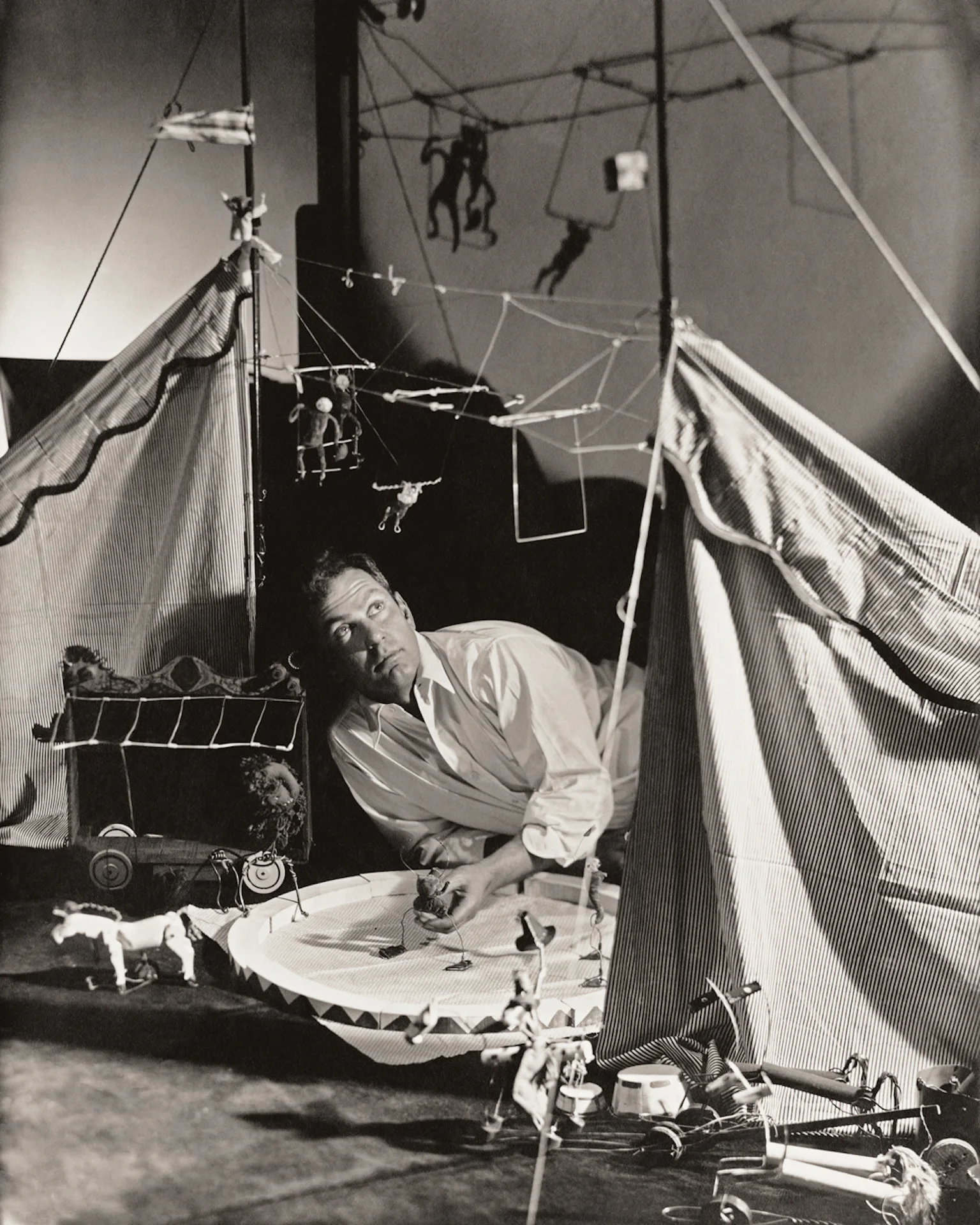
Photo: Alexander Calder, in Paris in 1930, with Cirque Calder, 1926–31. Photo by George Hoyningen-Huene, source
Explore photographs of the Cirque Calder at the Whitney Museum
In 1926, at twenty-eight, Calder moved to Paris and began constructing what became known as Cirque Calder (mainly developed between 1926 and 1931).
This was not a static sculptural representation of a circus. It was a portable, performative, miniature circus with acrobats, animals, trapeze artists, clowns, contortionists, props, and apparatus. Calder used materials such as:
- wire and metal;
- wood and cork;
- fabric and rubber;
- strings, cords, and small found objects.
The Whitney Museum of American Art, which holds the work, describes more than seventy human and animal figures, nearly one hundred accessories, and other musical instruments and props.
Calder transported the circus in suitcases and performed it for audiences in friends’ homes and artists’ studios, in France and the United States. Some performances lasted as long as two hours. He was puppeteer, machinist, narrator, sound-maker, stage manager, and performer.
Watch / explore: Whitney Museum — Calder’s Circus · High Wire: Calder’s Circus at 100
The mechanics of performance
A circus figure is meaningful because it performs an action. An acrobat must jump. Another balances. An animal changes posture. A trapeze artist swings. Calder developed little mechanical arrangements involving wire joints, levers, strings, handmade supports, gravity, and counterweights to make such events possible.
But the mechanics were only half the composition. Calder himself had to activate them, coordinate their timing, narrate what was happening, and respond to what the objects actually did.
It is helpful to distinguish:
- Object — the physical figure or apparatus.
- Mechanism — what movement its joints, strings, masses, and supports allow.
- Performance — the gesture and timing supplied by Calder.
- Event — the interaction of mechanism, performer, audience, and the possibility of unexpected outcomes.
This creates an astonishing continuity with his later kinetic work. The circus is already a laboratory for expressivity through physical action, before abstraction and before the motorized mobiles.
It is also a reminder that small mechanisms need not behave perfectly to be compelling. Small changes, awkwardness, chance, and occasional instability can contribute to the theatrical character of a performance.
Paris and the avant-garde: from figures to abstraction
In Paris, Calder encountered a network of artists whose ideas and practices transformed his understanding of form and movement.
Piet Mondrian: geometry and the imagined possibility of motion
A particularly important encounter occurred in October 1930, when Calder visited Piet Mondrian’s studio. Its arrangements of colored rectangles impressed him. Calder imagined how fascinating it might be if such colored elements could actually move. The visit was a decisive moment in his movement toward abstraction.
Joan Miró: organic forms and visual play

Photo: Painting (Head and Spider), 1925. sorce
Calder met Joan Miró in 1928, beginning a lasting friendship. Their work shares an affinity for playful, biomorphic shapes, spatial relationships, and compositions that can appear spontaneously alive. This is a useful comparison, though their artistic methods are not identical.
Marcel Duchamp: the name mobile
Marcel Duchamp had already explored devices and optical movement. In 1931, he suggested the term mobile for Calder’s moving sculptures. In French, the word holds associations with movement and motive. The term helped distinguish moving sculpture from conventional stationary sculpture.
Jean Arp: the name stabile

Photo: Growth ( Croissance ), 1938. source
Jean Arp was associated with the naming of Calder’s stabiles, his stationary abstract sculptures. The distinction between mobile and stabile was conceptual as well as descriptive: sculpture could now be composed through either literal movement or fixed relationships of forms in space.
Other artistic interlocutors included Fernand Léger and Theo van Doesburg. Calder also became involved in the Parisian abstract-art milieu, including Abstraction-Création.
So, yes: Calder was deeply embedded in the European avant-garde. But he was not simply illustrating the ideas of one school. He combined abstraction with a practical interest in motion, material forces, humor, and construction.
1931–1933: before the hanging mobiles, the electric motors
This was the discovery that most surprised me. Calder’s earliest abstract kinetic sculptures did not simply hang from the ceiling and respond to wind. Many of them used electric motors.
He experimented with supports, rotating arms, arcs, spheres, rods, strings, moving geometric shapes, and different relationships of speed and amplitude.
His interest was not just in making one object spin. It was in composing multiple movements in relation to one another.
A sculpture might contain slow and fast elements, small and large displacements, changing overlaps, and moving forms that seemed to approach or depart from one another. Movement became an element of composition on the same level as shape, color, or proportion.
Pantograph (1931)

Work: Pantograph (1931) — Calder Foundation
This early motorized sculpture was made using sheet metal, wood, wire, paint, and a motor. At approximately 90 cm high, it is a striking example of Calder’s transition from representational wire constructions to abstract machines. It appeared in the historical Paris exhibition Calder: ses mobiles in 1932.
The title refers to a pantograph, a device for mechanically reproducing or transforming trajectories. We should not, however, assume its internal transmission is identical to a conventional drawing pantograph without examining the particular object.
What I want to study: the support geometry, articulation, possible motion transmission, and how the motor drives the visible forms.
Double Arc and Sphere (1932)

Work: Double Arc and Sphere (1932) — Calder Foundation
Video: Watch Double Arc and Sphere in motion
The sculpture employs wood, wire, rod, string, paint, and an electric motor. Arcs and a sphere form a composition whose identity emerges through changing positions and trajectories.
This is a particularly useful study of how an arrangement of relatively simple geometric elements becomes complex through timing. Calder at times painted supports white against a white background to reduce their visual presence; the moving forms, rather than the apparatus holding them, became the primary focus.
What I want to study: how many independent movements are present, what paths they follow, and whether their relative timing creates the perception of a relationship between the forms.
Dancing Torpedo Shape (1932)

Work: Dancing Torpedo Shape (1932) — Calder Foundation
An elongated black form, a small metal element, and a sphere belong to an arrangement of rods and supports. Rather than presenting a single symmetrical rotation, it is a study of different rhythms, visual weights, paths, and motion amplitudes. The Calder Foundation lists the work as approximately 73 cm high.
What I want to study: how one drive or several mechanical connections distribute motion across the parts, and what determines the apparent ‘dance’. Photographs alone do not establish the exact transmission system.
Half-circle, Quarter-circle and Sphere (1932)

Work: Half-circle, Quarter-circle and Sphere (1932) — Calder Foundation
This motorized construction combines geometric metal shapes with a comparatively tall structure — nearly two meters — made with wood, rods, sheet metal, and motorized components.
What I want to study: movement at architectural or bodily scale, spatial relationships between geometries, and the engineering of its structure.
Machine motorisée (1933)

Work: Machine motorisée (1933) — Calder Foundation
Made of wood, wire, paint, and a motor, this work has an especially useful archival record: a photograph made by Marc Vaux in 1933 identifies the machine while moving. This offers a rare historical glimpse of the motorized experimental moment, even if a still photograph does not reconstruct the entire motion.
What I want to study: how to read evidence of motion from archival documentation without projecting mechanical details that cannot be confirmed.
A Universe (1934): motors did not immediately disappear

Work: A Universe (1934) — Calder Foundation
Calder continued exploring motorized abstract sculpture beyond 1933. A Universe, made using iron tubing, wire, wood, string, and a motor, explores orbit-like movement and different temporal relationships.
It would be inaccurate to claim that he simply discarded motors the moment he invented hanging mobiles. Different kinetic approaches overlapped in his practice.
Why did he come to favor balance and moving air?
Calder did not abandon motors because machines were inherently uninteresting to him. In fact, motors offered something valuable: the possibility of choreographing movement and coordinating different sequences using cams and other mechanisms.
But there were trade-offs:
- A motor can establish a specific timing, trajectory, and repetition.
- More elaborate mechanisms require adjustment, maintenance, and reliable operation.
- A cycle programmed mechanically may repeat predictably.
- A freely suspended structure introduces a different degree of variation because its motion depends on air, gravity, inertia, mass distribution, and small disturbances.
Historical accounts describe mechanical difficulties in his early motorized work. Calder also later reflected on how motorized sculptures could become repetitive. These recollections should not be reduced to a simplistic ‘motors bad, wind good’ narrative. He was exploring different kinds of kinetic composition.
The suspended mobile allowed him to design conditions without prescribing every future state of the sculpture.
What changes in a suspended mobile?

See Lobster Trap and Fish Tail (1939) at MoMA
A suspended mobile is a physical system organized through:
weight → lever arms → suspension points → center of mass → torque → balance → air movement → time.
The composition changes as its parts respond to one another and to the surrounding environment. A moving element shifts relationships with other elements, shadows, the architecture, and the viewer.
It is not literally alive or autonomous in the biological sense. Nevertheless, its sensitivity to conditions can invite the viewer to perceive the movement as delicate, tentative, lively, slow, or playful.
That difference between what physically happens and what we emotionally perceive is extremely important for Artificial Emotion.
A mechanical ballet: movement as choreography
There is another Calder worth studying between the circus and the mature mobiles: his experiments with mechanical ballet and small moving stages. Around 1933, he devised a kind of miniature kinetic theater with colored disks, cones, pennants, and pulleys, producing distinct gestures and interactions.
This takes us directly back to the Cirque Calder. A small apparatus can generate an event or a sequence; two shapes can seem to be pursuing, confronting, or responding to each other even though their motion has a purely mechanical explanation.
The filmmaker Jean Painlevé filmed Calder’s moving constructions in 1933, among the earliest film records of the mobiles. The Calder Foundation’s archives are a useful point of departure for further locating and examining this footage.
Research question: how much of what we call an object’s ‘personality’ comes from its material appearance, and how much comes from the temporal relations among its movements?
Metal was not merely an aesthetic signature

Photo: Portrait of a Man, 1928 source
Calder is often remembered for black wire, thin rods, and colorful metal sheets. But the material palette of his practice was broader, especially in the circus.
With wire, he could draw in space: a continuous line becomes a portrait, an animal, a joint, or an armature.
With sheet metal, he could cut distinct surfaces that were visually legible, mechanically useful, and responsive to moving air.
With supports, rods, pivots, and strings, he could arrange masses in space and transfer force or motion.
With large steel plates, he eventually created monumental stabiles, often relying on industrial fabrication and assembly techniques.
The practical brilliance is that shape and mechanical behavior are inseparable. A piece of metal does not simply resemble something; its length, stiffness, thickness, weight, connection, and position make certain movements possible and others impossible.
This makes Calder’s work useful for contemporary physical prototyping: a mechanical decision can be a compositional decision at the same time.
Recognition, travel, and life between artistic worlds
Calder was recognized during his lifetime — not only posthumously. The Cirque Calder helped him build an audience within artistic circles, while abstract mobiles and stabiles gained attention through exhibitions and major museums.
| Year | Event |
|---|---|
| 1898 | Born in Philadelphia, USA. |
| 1909 | As a child, makes small folded-brass animal sculptures, including a dog and duck. |
| 1919 | Graduates in mechanical engineering from Stevens Institute of Technology. |
| 1923 | Begins studying art at the Art Students League in New York. |
| 1925 | Draws circus performances for the National Police Gazette. |
| 1926 | Moves to Paris; begins Cirque Calder. |
| 1928 | Meets Joan Miró. |
| 1930 | Visits Mondrian’s studio and moves decisively toward abstraction. |
| 1931–1933 | Creates experimental abstract kinetic sculpture, including motorized works. |
| 1933 | Returns to the United States and establishes a base in Connecticut. |
| 1934 | Creates A Universe, continuing motorized investigations. |
| 1943 | Major retrospective at the Museum of Modern Art, New York. |
| 1952 | Wins the Grand Prize for Sculpture at the Venice Biennale. |
| 1963 | Establishes a large studio in Saché, France, and works at monumental scale. |
| 1964–1965 | Retrospective at the Solomon R. Guggenheim Museum. |
| 1976 | Dies in New York, aged 78. |
France remained important in his life and practice; he also traveled internationally, including to Europe, South America, and Asia. His work connected intimate performative constructions, avant-garde studios, museum exhibitions, and public monuments.
What I take from his artistic mindset
The following is my interpretation, rather than a claim that Calder himself formulated a single artistic method.
1. Play is not the opposite of serious inquiry.
The circus was not merely an amusing preliminary to his ‘real’ sculpture. It was years of investigation into mechanisms, timing, spectatorship, and expressivity.
2. Thinking can happen through making.
A wire, pivot, rod, or sheet of metal is not simply material used after a design is complete. Its constraints and possibilities can generate the idea.
3. A composition need not exist in one fixed state.
A kinetic sculpture develops across time. A shape’s significance changes when it moves relative to other shapes.
4. Less control can sometimes produce greater variation.
Motors allow choreography. Suspended structures allow interaction with atmospheric and mechanical conditions. Neither approach is inherently superior; they make different experiences possible.
5. The behavior of an object can invite emotional interpretation.
We may perceive dialogue, hesitation, surprise, or calm in forms that simply obey mechanical and physical laws.
What this opens up for Artificial Emotion
The most useful connection is not the recognizable Calder aesthetic of black lines and primary-colored metal shapes. It is the succession of three distinct ways of composing movement:
1. Performed movement — Cirque Calder
The artist supplies energy, timing, narrative, and gesture. The mechanism constrains and translates his actions. Expression is inseparable from performance.
Contact / manipulation → mechanism → action → audience interpretation.
2. Mechanically driven movement — early motorized mobiles
A motor and transmission determine trajectories and rhythms. The artistic work consists in composing relations between those movements. Expression emerges from choreography, phase, timing, and mechanical transformation.
Motor → transmission → several movements → perceived relation.
3. Environmentally responsive movement — suspended mobiles
The artist determines geometry, weights, connections, and balancing conditions, but the environment helps determine actual movement. Expression emerges from a sensitive relationship with surrounding forces.
Air / disturbance → balance and inertia → motion → perceived behavior.
These are not steps in a hierarchy or a story in which one technology is replaced by a more advanced one. They are different strategies. For Artificial Emotion, all three remain useful.
In ongoing experiments with small stepper motors such as the 28BYJ-48, crank mechanisms, eccentric cams, pulley systems, suspensions, and counterweights, I can investigate related questions at a modest physical scale:
- Can one motor drive several elements at different speeds or amplitudes?
- What happens if one shape moves quickly while another returns slowly?
- Can a cam profile produce quick motion, a pause, and a gradual return without relying on software choreography?
- How does a viewer interpret two objects moving in different rhythms — as independent motion, or as a dialogue?
- When do small inaccuracies and physical variations become perceptually meaningful rather than merely technical defects?
- How does exposure of the mechanical structure change what the viewer perceives?
- Can counterweights and air currents make a motor-driven object more sensitive and less rigidly repetitive?
The question is not simply how to make an object represent an emotion. It is:
How can a physical system produce changing relationships that make an object appear to behave?
And perhaps more specifically:
At what point do different mechanical rhythms begin to look like a relationship between things?
That is a powerful point of departure for studying expressive kinetics without assuming that the machine itself has feelings or intentions.
A mental map
Alexander Calder — 1898–1976
Origins
→ Philadelphia / United States
→ father and grandfather: sculptors
→ mother: painter
→ childhood tools, brass figures, making things
→ mechanical engineering
1919–1926
→ engineering jobs and other occupations
→ Art Students League
→ illustration and drawing
→ observations of circus performers
1926–1930
→ Paris
→ Cirque Calder
→ portable wire figures
→ manual performance
→ avant-garde networks
→ Miró and Mondrian
1931–1934
→ abstraction
→ Duchamp and the name mobile
→ motors, rods, arcs, spheres
→ movement composition
→ experiments in mechanical choreography
1930s onward
→ suspended mobiles
→ balance / gravity / air / inertia
→ stationary stabiles
→ large public sculptures
→ international recognition
Recurring interests
wire
metal
balance
gravity
air
motor
rhythm
performance
humor
time
movement as composition.
Works and footage to examine next
- Cirque Calder — Whitney Museum collection — figures and small performative devices; focus on manipulation, balance, and the relation between mechanism and performance.
- Alexander Calder: From the Circus to the Moon (1963) — Hans Richter’s film, valuable for observing Calder and his objects in motion.
- Pantograph (1931) — an early abstract motorized construction.
- Double Arc and Sphere (1932) — an essential motion study. Video of the work operating.
- Dancing Torpedo Shape (1932) — investigate timing and rhythm among differently shaped elements.
- Half-circle, Quarter-circle and Sphere (1932) — movement and structural scale.
- Machine motorisée (1933) — historical documentation of a motorized sculpture in motion.
- A Universe (1934) — demonstrates that motors and freely moving mobiles overlapped in Calder’s investigations.
- Calder, Statement (1933) — Calder’s own words on composing movements of different types, speeds, and amplitudes.
Sources
- Calder Foundation — Introduction and biography. Introduction.
- Calder Foundation — Chronology, 1898–1925. Early development.
- Calder Foundation — Works and archive. Works · Timeline.
- Calder Foundation — Statement (1933). Primary text.
- Whitney Museum of American Art — Calder’s Circus. Collection.
- Whitney Museum of American Art — High Wire: Calder’s Circus at 100. Exhibition.
- Calder Foundation — From the Circus to the Moon (1963), Hans Richter. Film.
- Calder Foundation — individual catalogue records for Pantograph, Double Arc and Sphere, Dancing Torpedo Shape, Half-circle, Quarter-circle and Sphere, Machine motorisée, and A Universe.
Research note: Physical descriptions and art-historical chronology are distinguished from the author’s interpretations and proposed mechanical experiments. Detailed motor/transmission architecture should be established from technical documentation or direct examination, not inferred solely from photographs.