If the Tin Man Had a Heart
A one-hour cardboard, foil and motor prototype made during the Sensitive Machines hackathon at IFT in Paris, before Artificial Emotion had a name.
Before Artificial Emotion had a name
The idea that would later become Artificial Emotion began during the Sensitive Machines hackathon at the Institute for Future Technologies — IFT in Paris.
I was there for a week of teaching, prototyping and conversation around the beginning of the Creative Technology programme. The students were working with simple electronics, physical interaction and rapid prototyping, asking what it might mean for a machine to appear sensitive, responsive or expressive.
On the final day, after spending the week supporting everyone else's experiments, Mariana Tamashiro, Paul Ecoffet and I decided that we also wanted to make something.
The idea was deliberately simple and playful:
What if the Tin Man had a heart?
It was a reference to The Wizard of Oz, but also an excuse to make a machine whose movement could immediately be read as something bodily and emotional.
At that point, there was no project called Artificial Emotion.
There was only a heart we wanted to make move.
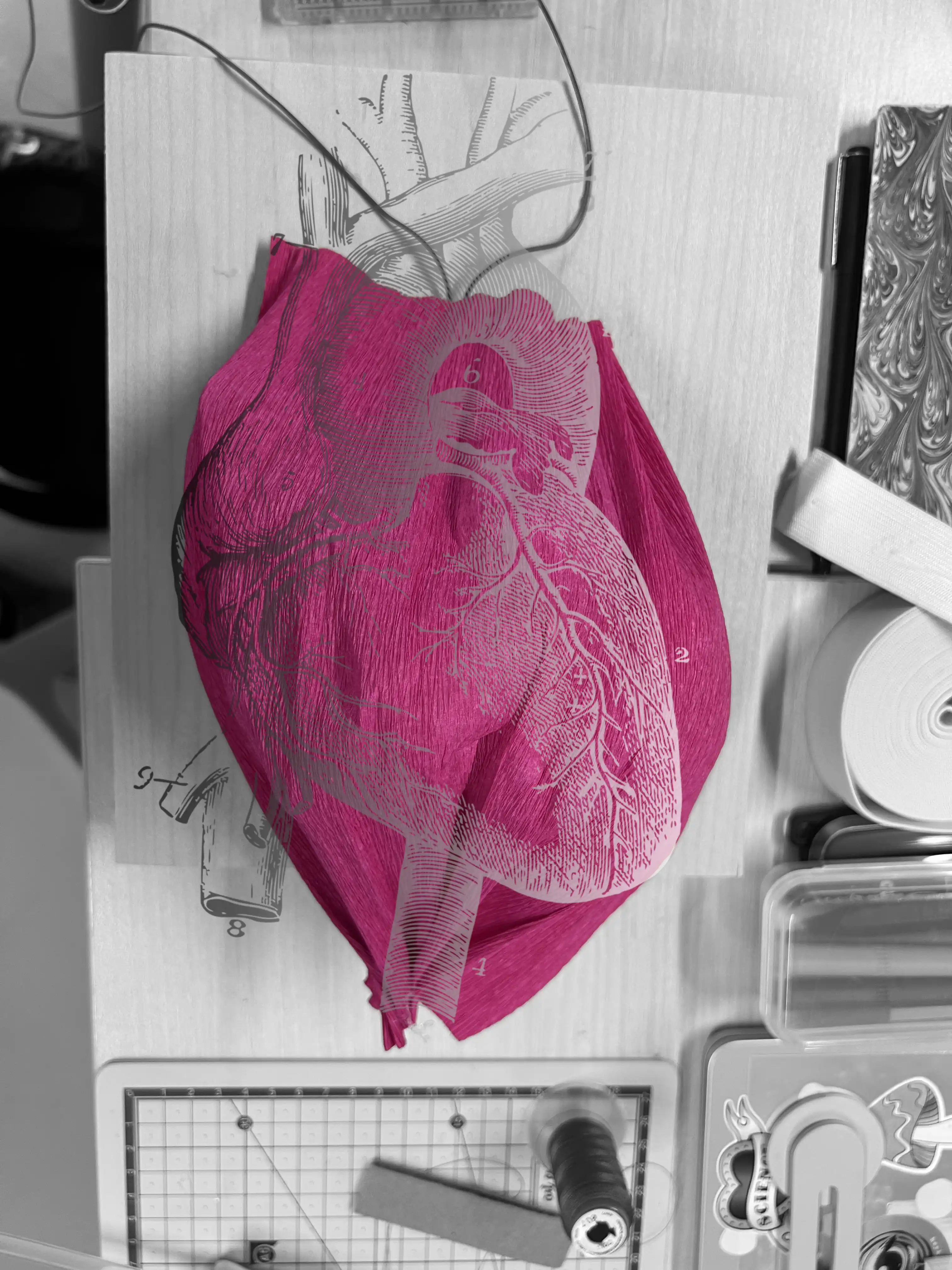
The first moving heart prototype, built during the final day of the Sensitive Machines hackathon at IFT. Detail of the first heart mechanism: a small DC motor with an eccentric shaft striking the cardboard structure from inside. the heart shape made from 4 pieces of crumpled aluminum foil
Building the heart
We used what was already available in the prototyping kit and around the workshop.
A small DC motor became the actuator.
The structure was made quickly from cardboard and hot glue. Mariana shaped pieces of aluminium foil into the approximate volumes of an anatomical heart. From the beginning, we were interested in the recognisable asymmetry and multiple volumes of an anatomical heart rather than the symmetrical heart symbol.
We did not have the fabric or stretch mesh we might normally have chosen for a soft outer skin, so we improvised with crepe paper.
Inside the structure, the rotating motor struck the cardboard and transmitted movement into the foil volumes and the paper covering them.
The mechanism was crude.
That was completely fine.
Within roughly an hour, the object was moving.
Making together
Part of what made the prototype important was the way it was made.
There was no attempt to divide the work into clean disciplinary roles.
Mariana was particularly comfortable with the manual construction and shaped the foil volumes.
Paul, whose practice was much more connected to software and computation, was enjoying working directly with Arduino, motors and the physical unpredictability of a kinetic object.
I was interested in the mechanism, the body of the object and how very little movement was needed before the heart started to feel animate.
I showed Paul a short video of an earlier kinetic work of mine. It became part of the conversation about motors, repetition and installation, and about the difference between making movement function and making movement communicate something.
The prototype emerged through that exchange rather than through a predetermined design.
A sensitive machine
The heart did not sense anything.
It was not interactive.
It did not need to be.
What interested me was that a very simple mechanical action already produced an emotional reading.
A motor rotated.
Something struck something else.
Four loosely constructed volumes moved under a thin paper skin.
And the object appeared to beat.
That small shift — from mechanical movement to perceived bodily behaviour — stayed with me after the hackathon.
The theme Sensitive Machines had initially been a context for the workshop. Through this prototype, it became a question I wanted to continue investigating.
How does a machine acquire a bodily presence?
When does repetitive movement begin to look hesitant, tense, vulnerable or alive?
How much mechanism is necessary before we project emotion onto an object?
The first heart
Looking back, this was the first physical gesture of what would become Artificial Emotion.
The later research would move toward stepper motors, soft mechanisms, kinetic modules, biosignals and more controlled studies of movement.
None of that existed yet.
This object was made from cardboard, aluminium foil, crepe paper, hot glue and a small DC motor, in about an hour, because three people at the end of a hackathon wanted to have some fun and build a heart.
That informality matters.
The project did not begin with a research plan.
It began with making something move and noticing that the movement suggested more than the mechanism itself could explain.
Context
The prototype was made at the Institute for Future Technologies (IFT), part of De Vinci Higher Education in Paris, during the Sensitive Machines hackathon connected to the Creative Technology major.
At IFT, Mariana Tamashiro works across creative learning, design and technology, and was part of the teaching context around the programme. Paul-Peter Arslan also taught in the Creative Technology major while developing research across computation, human-computer interaction, AI, music and human movement.
The environment around the hackathon — engineers prototyping quickly, physical materials mixed with code, and permission to make incomplete things — became one of the conditions from which Artificial Emotion emerged.
Photo: The wider group at IFT during the week in Paris.